search
Search

Enter keywords to search for products, blog posts, and more.


Home > Ceramic Orifice Corrugated Packing

Ceramic Orifice Corrugated Packing

Ceramic Orifice Corrugated Packing

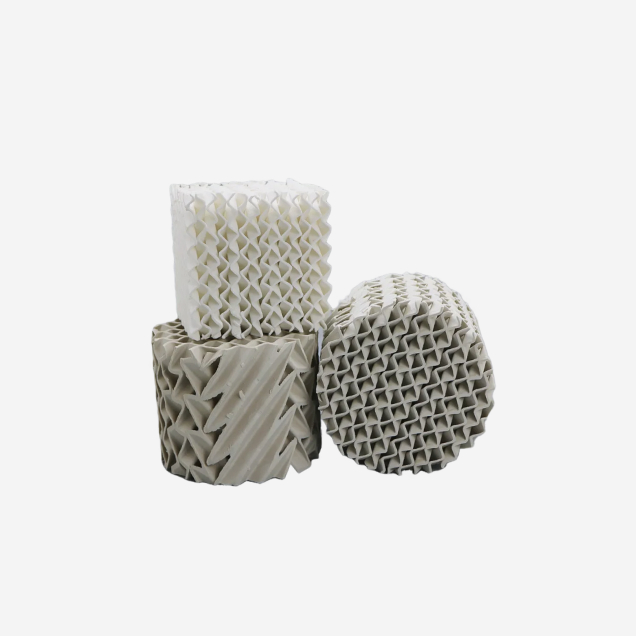
Ceramic orifice corrugated packing is made from corrugated porcelain sheets, perforated and bonded into rigid blocks that drop into the column as the separation stage. Its real strength is taking heat and corrosion at the same time — the fired body keeps its shape and chemical stability past the point where plastic softens and metal begins to rust. Porcelain also wets well, so it spreads a thin, fast-draining liquid film that raises separation efficiency and cuts the risk of coking, polymerisation and fouling.

  • Corrugated porcelain plates, perforated to move liquid across the pack and hold the film even.
  • Models 125Y, 250Y, 350Y, 450Y and 700Y, giving specific surface area from 125 to 700 m²/m³.
  • Runs hot — service temperature up to around 1000°C, far above what plastic can take.
  • Strong acid and corrosion resistance, steady against H2S, chloride and naphthenic acid attack.
  • Low pressure drop, wide turndown and little scale-up effect from pilot column to full tower.

Technial Parameters

PropertyValue
Product TypeCeramic structured packing (corrugated, perforated plate)
Model NO.RJ-1305
MaterialChemical porcelain (kaolin-based ceramic)
ColorLight grey
FormRound or rectangular blocks
Specification125Y, 250Y, 350Y, 450Y, 700Y
Specific Surface Area125–700 m²/m³ (by model)
Corrugation Angle45° (Y series)
Max Operating TemperatureUp to about 1000°C
Chemical ResistanceStrong acid and corrosion resistance; stable to most solvents
Main FunctionHigh separation efficiency, low pressure drop, low liquid holdup
ApplicationsDistillation, absorption, acid recovery, gas purification
TrademarkRONGJIAN
OriginJiangxi, China
HS Code6909190000
Transport PackageSteel drum / carton box / ton bag
Production Capacity10000 tons/year

FAQs

Which processes is ceramic structured packing used in?

Ceramic structured packing goes into distillation, rectification and absorption columns that run corrosive or high-temperature service. Common duty includes sulfuric acid drying and absorption, nitric acid concentration, distillation of halogenated and chlorinated organics, and gas purification in fertiliser and chemical plants. It also works under vacuum and as a mist eliminator or catalyst carrier. Wherever the medium is aggressive and the column needs a tight, stable separation, ceramic is a standard fit.

When should I choose ceramic over metal or plastic packing?

Pick ceramic when heat and corrosion show up together. Plastic packing is lighter and cheaper but softens once the stream runs hot, and metal handles heat but corrodes in acids, chlorides and sulfur-bearing media. Fired porcelain holds both, staying rigid at high temperature while shrugging off most acids and solvents. So for hot acid service, halogenated distillation or any duty that would attack metal and melt plastic, ceramic is the safe call. For cool, clean, low-pressure-drop work, plastic or metal may be the lighter, lower-cost option.

What temperature and chemicals can ceramic packing handle?

On temperature, ceramic packing takes continuous service up to around 1000°C, well past plastic and comfortable where metal would be near its limit in corrosive heat. On chemistry, the porcelain body resists acids, salts and organic solvents, and holds up against H2S, chloride and naphthenic acid that eat into metal. Very strong hot alkali and hydrofluoric acid are the usual exceptions to watch for.

Do you supply custom sizes, and how is ceramic packing packed for shipping?

Yes. Beyond the standard 125Y to 700Y models we cut the blocks to round or rectangular sections that fit the tower cross-section, and adjust the corrugation for the separation and pressure-drop target. Because ceramic is rigid and brittle, transport packing matters: units are foam-cushioned and stacked in steel drums, cartons or ton bags, then braced for export so they arrive intact. For a fragile-freight quote we work from your tower diameter, the models and the target volume.

Ceramic orifice corrugated packing is formed from chemical porcelain — kaolin-based clay pressed into thin corrugated sheets, perforated, then fired into hard blocks. The plastic version is welded from foils; the ceramic version gets its strength and heat tolerance from the firing, which is why it can sit in a column running near 1000°C without deforming. The sheets are set at a 45° or 60° angle and turned against each other, so gas and liquid follow crossing, tortuous channels and keep mixing down the bed.

The surface does a lot of the work. Porcelain is hydrophilic, so liquid spreads into a thin, even film that drains fast and leaves little holdup in the pack. That quick film turnover keeps hot spots, polymerisation and coking down, which is a real advantage in reactive and fouling-prone distillation. The perforations add cross-mixing between channels and even out the liquid load, so the separation stays stable across a wide band of gas and liquid rates.

Material choice usually comes down to three options, and it pays to match the packing to both the temperature and the chemistry before deciding:

MaterialTemperatureCorrosionBest fit
CeramicUp to ~1000°CResists acids, chloride, H2SHot, corrosive, reactive distillation and acid recovery
MetalVery highCorrodes in acids and chlorideClean, hot, non-corrosive duty needing high capacity
PlasticUp to ~150°C (PTFE higher)Excellent vs acids and alkalisCool, corrosive scrubbing and stripping

Typical ceramic duty covers sulfuric acid drying and absorption, nitric acid concentration, chlorinated and halogenated organic distillation, and gas purification in fertiliser and petrochemical plants, including vacuum columns where a low, steady pressure drop matters. Two practical points at install: the blocks are heavy and brittle, so they go in by hand in layers with extra care at the wall, and each layer is turned against the one below to keep the flow crossing. Loaded and installed properly, a ceramic bed runs for years in service that would corrode metal or melt plastic.