search
Search

Enter keywords to search for products, blog posts, and more.


Home > Metal Orifice Corrugated Packing

Metal Orifice Corrugated Packing

Metal Orifice Corrugated Packing

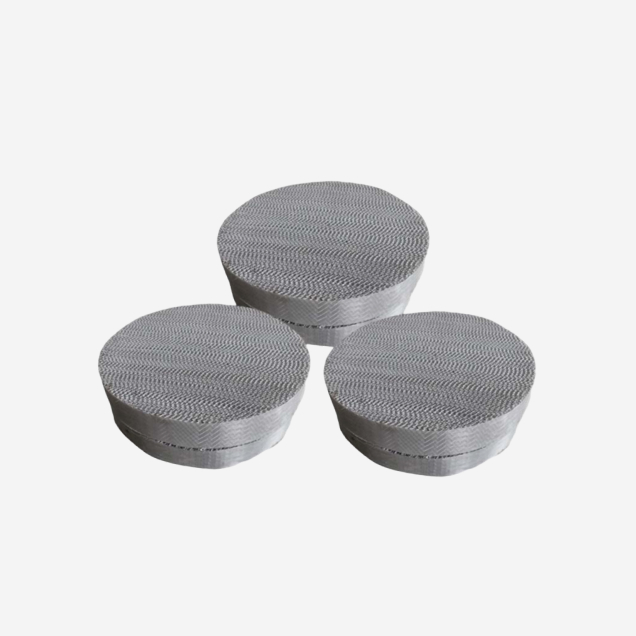
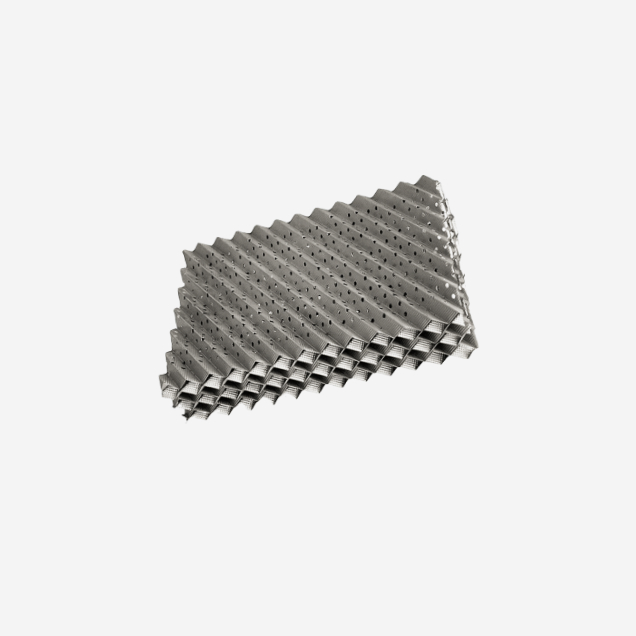
Metal orifice corrugated packing is a stainless steel structured packing built from perforated, corrugated sheets, used in distillation, absorption and stripping columns. The corrugated channels spread the liquid and vapor evenly for a high mass-transfer efficiency at a low pressure drop and high capacity, and the metal takes corrosive service and cleans easily.

  • High mass-transfer efficiency from the corrugated, perforated sheet structure.
  • Low pressure drop and high capacity — low pressure, high flux.
  • Corrosion-resistant stainless steel, with copper and other alloys on request.
  • Anti-clogging, smooth surface that is easy to clean and maintain.
  • Y-type (45°) and X-type (30°) in 125, 250, 350 and 500 m²/m³.

Technial Parameters

PropertyValue
MaterialStainless steel (304 / 316 / 316L); copper on request
TypeMetal corrugated-plate structured packing (perforated / orifice sheets)
Sizes125Y, 250Y, 350Y, 500Y (45° corrugation) and 125X, 250X, 350X, 500X (30°)
Specific Surface Area125–500 m²/m³ (by type)
Void Fraction92–98%
Bulk Density53–180 kg/m³
Pressure DropLow, about 140–400 Pa/m
Theoretical Stages~1–4.5 per metre (by type)
AdvantageHigh efficiency, low pressure drop, high capacity, anti-fouling, easy to clean
ApplicationDistillation, absorption and stripping columns — petroleum, coal chemical, desulfurization, denitrogenation
HS Code8419909000
TrademarkRONGJIAN
OriginJiangxi, China
Transport PackageCarton box / ton bag / steel drum

FAQs

What is metal orifice corrugated packing used for?

Metal orifice corrugated packing is a structured packing for distillation, absorption and stripping columns, used across petroleum refining, coal chemical, gas-treating and fine chemical plants — for jobs such as separation, distillation, desulfurization and nitrogen removal. The corrugated sheets spread the vapor and liquid across the column for efficient mass transfer at a low pressure drop, which suits both atmospheric and vacuum service.

What is the difference between Y-type and X-type?

The difference is the corrugation angle. Y-type sheets are corrugated at forty-five degrees, giving higher efficiency and a moderate capacity, and are the general-purpose choice; X-type sheets are at thirty degrees, giving a higher capacity and a lower pressure drop for high-load or vacuum columns. Both come in the same surface-area sizes, so the type is chosen for the balance of efficiency and capacity.

What materials and sizes are available?

The packing is made from stainless steel — commonly 304, 316 or 316L — with copper and other alloys available for a specific service, and in sizes from 125 up to 500, where the number is the surface area in square metres per cubic metre. A higher number means more surface area and efficiency but less open space, so the size is matched to the separation and the load.

How do I select a packing size, and how is it packed?

The size is chosen from the separation duty and the vapor and liquid loads — a fine separation wants a high surface area, a high-throughput or vacuum column wants a more open type. Send the column diameter, the service and the duty and we will recommend the type and the size. The packing ships in cartons, ton bags or steel drums.

Structured packing is chosen on two competing numbers: efficiency and capacity. A higher surface area — 500 over 125 — packs more mass-transfer area into the column and gives more theoretical stages per metre, but leaves less open space, so it handles a lower load before flooding. The corrugation angle trades the same way: the forty-five-degree Y-type is more efficient, the thirty-degree X-type takes more load at a lower pressure drop. Stainless steel gives the corrosion resistance and the smooth, anti-fouling surface for a long, clean-running life, and copper or other alloys can be supplied where the process needs them. The size and type are matched to the separation, the loads and the column.