search
Search

Enter keywords to search for products, blog posts, and more.


Home > Corrugated Wire Mesh Packing

Corrugated Wire Mesh Packing

Corrugated Wire Mesh Packing

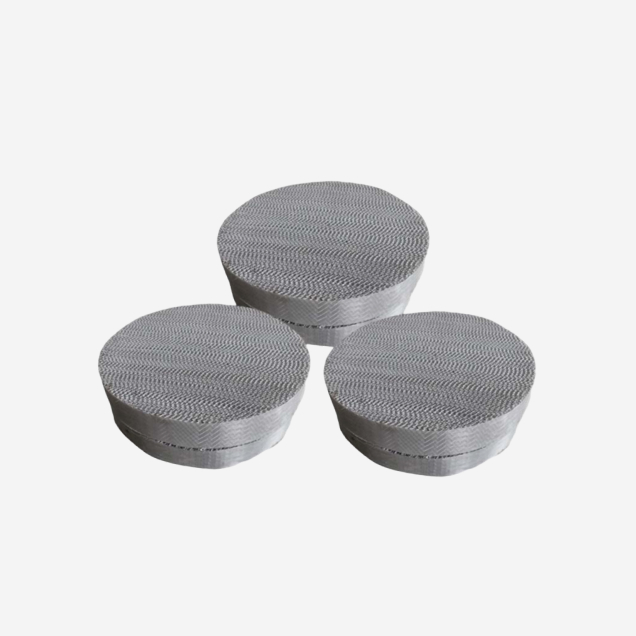
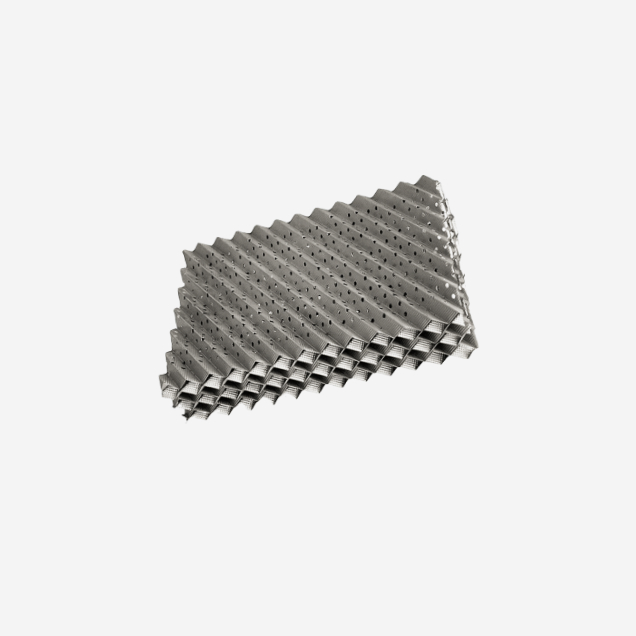
Corrugated wire mesh packing is a metal wire-gauze structured packing, the highest-efficiency packing for demanding separations. Woven from fine metal mesh into corrugated sheets, it wets by capillary action, so the liquid spreads across the whole surface even at very low loads, giving a high number of theoretical stages per metre at a low pressure drop. It is the packing of choice for precision and vacuum distillation.

  • Wire-gauze structure: the highest separation efficiency, with many stages per metre.
  • Capillary wetting spreads liquid evenly even at low loads, for a wide turndown.
  • Low pressure drop per theoretical stage, ideal for vacuum service.
  • Stainless steel (304/316), carbon steel or special alloys for corrosive duties.
  • For precision, vacuum, close-boiling and heat-sensitive separations; 500Y and 700Y.

Technial Parameters

PropertyValue
MaterialStainless steel (304 / 316 / 316L), carbon steel or special alloys
TypeMetal wire-gauze (mesh) corrugated structured packing
Sizes500Y, 700Y (CY / BX types)
Specific Surface Area500–700 m²/m³
EfficiencyVery high — several theoretical stages per metre
Void Fraction~90% and above
Corrugation Angle45° (Y)
WettingCapillary action — excellent wetting even at low liquid loads
AdvantageHighest separation efficiency, low pressure drop per stage, wide turndown
ApplicationPrecision and vacuum distillation, close-boiling and heat-sensitive separations, high-purity and fine-chemical columns
FormRound or rectangular blocks, made to the column
HS Code8419909000
TrademarkRONGJIAN
OriginJiangxi, China
Transport PackageCarton box / ton bag / steel drum

FAQs

What is corrugated wire mesh packing used for?

Corrugated wire mesh packing is the high-efficiency structured packing used where the separation is difficult — vacuum distillation, close-boiling mixtures, heat-sensitive products, and high-purity and fine-chemical work. The woven mesh wets by capillary action, so it performs even at very low liquid loads, and it delivers the most theoretical stages per metre of any packing, which is what precision separation needs.

How is wire mesh packing different from plate packing?

Wire mesh packing is woven from fine metal gauze, while plate packing is made from perforated sheet. The gauze gives a larger surface area and far better wetting, so it reaches a higher efficiency — more theoretical stages per metre — but at a lower capacity and a higher cost. Plate packing takes more throughput; wire mesh is chosen when efficiency, vacuum performance or a wide turndown matters more.

What efficiency and sizes does it offer?

Wire mesh packing offers the highest efficiency of the structured packings, on the order of several theoretical stages per metre, with a low pressure drop per stage that suits vacuum columns. It is made in high-surface-area sizes such as 500Y and 700Y — the figure being the packing's surface area per unit volume — and the size follows the separation and the column.

What materials are available, and how is it packed?

It is woven in stainless steel — 304, 316 and 316L are the usual grades — or in carbon steel or a special alloy for a given service, and cut as round or rectangular blocks to the column bore. Packing goes out in cartons, ton bags or steel drums. Tell us the column bore, the service and the separation and we will match the type and the size.

Wire gauze packing sits at the top of the efficiency scale. Because the woven mesh wicks liquid by capillary action, the whole surface stays wetted even when the liquid load is very low — exactly the condition inside a vacuum column — so it delivers more theoretical stages per metre than any plate packing, at a low pressure drop per stage. That is why it is used for close-boiling and heat-sensitive separations, high-purity products, and fine-chemical, pharmaceutical and essential-oil distillation. The trade is capacity and cost: it handles less throughput than plate packing and costs more, so it is chosen where the separation, not the volume, sets the design. Stainless steel and special alloys cover the corrosive duties.