search
Search

Enter keywords to search for products, blog posts, and more.


Home > MBBR Biofilm Carrier Media

MBBR Biofilm Carrier Media

MBBR Biofilm Carrier Media

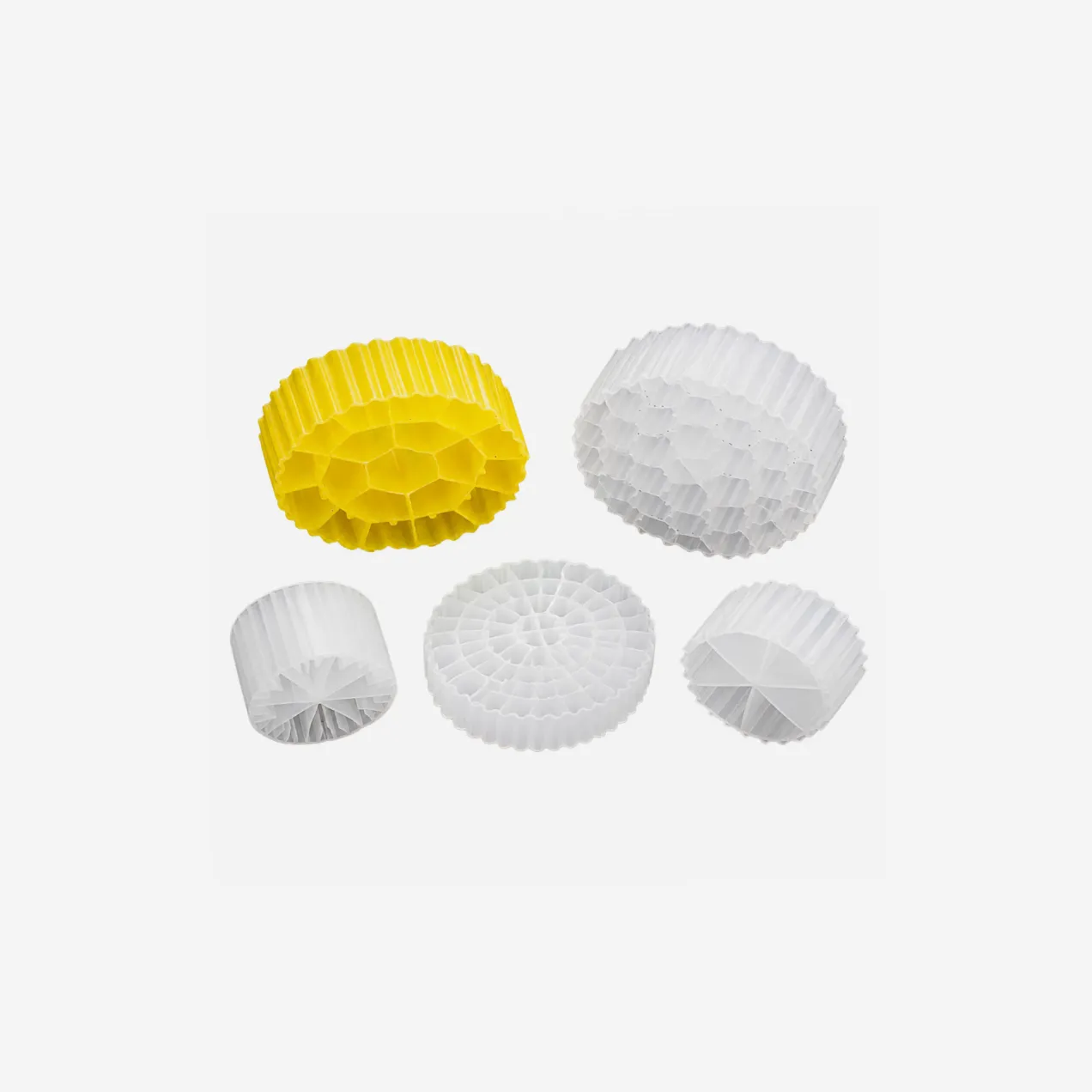
MBBR biofilm carrier media is a small HDPE plastic carrier — the K1 type — used to grow the bacteria that clean wastewater. In an MBBR (moving bed biofilm reactor) tank, thousands of these carriers are tipped loose into the water and kept tumbling by the aeration, filling 15 to 70 percent of the tank. Each carrier is a short cylinder with a cross-shaped web of walls inside and fins around the outside; bacteria grow as a biofilm on the sheltered inner walls, where the fins and the cross protect them from being knocked off as the carriers collide. As the media tumble, that biofilm is carried through the wastewater over and over, consuming the organic pollutants and ammonia. The internal structure packs a large protected surface — more than 900 m² in every cubic metre of media — into a small volume, so a great deal of treatment happens in a compact tank. Made of HDPE with a density just below water (about 0.94 to 0.98), the carriers suspend and move on gentle aeration. Model RJ-2900.

  • K1-type HDPE moving-bed carrier: grows biofilm to treat wastewater.
  • Cross internal walls + outer fins shelter the biofilm from scouring as media tumble.
  • Protected surface over 900 m²/m³; fill 15 to 70 percent of the tank.
  • Density just below water (0.94–0.98 g/cm³): suspends and moves on aeration.
  • Void over 86.5%; biofilm forms in 5–15 days; sizes ~10–25 mm; model RJ-2900.

Technial Parameters

ParameterValue
TypeMBBR biofilm carrier (K1 moving-bed media)
MaterialHDPE
ColourWhite
Surface area> 900 m²/m³
Porosity / void85% (void > 86.5%)
Density0.94–0.98 g/cm³
Fill / dosing ratio15%–70%
Carriers per m³> 839,000
Biofilm formation5–15 days
Max temperature< 65 °C
Sizes25×12, 16×10, 10×7, 11×7 mm (etc.)
CertificateISO9001


PropertyValue
Product TypeMBBR biofilm carrier media (K1 moving-bed carrier)
FunctionGrows biofilm on loose carriers tumbling in the aeration tank; treats wastewater
Model NO.RJ-2900
MaterialHDPE
StructureCylinder with internal cross walls and external fins
Surface Area>900 m²/m³
Void / Porosity>86.5% / 85%
Density0.94–0.98 g/cm³ (suspends near neutral buoyancy)
Fill Ratio15%–70% of tank volume
Biofilm Formation5–15 days
Max Temperature<65 °C
Sizes25×12, 16×10, 10×7, 11×7 mm
AdvantagesHigh protected surface, no sludge return, no clogging, shock-resistant, easy retrofit
ApplicationsMunicipal and industrial wastewater; BOD/COD removal and nitrification; new plants and upgrades
CertificateISO9001
TrademarkRONGJIAN
OriginChina
HS Code3926909090 for plastic media (not shown on listing; 8419909000 as a plant-part alternative — confirm)
Transport PackageTon bags

FAQs

What is MBBR biofilm carrier media, and how does it work?

MBBR biofilm carrier media are the small plastic pieces that do the biological work in a moving bed biofilm reactor, one of the common ways to treat sewage and industrial wastewater. The idea is simple. The bacteria that break down the pollutants in wastewater need a surface to grow on. In an MBBR, that surface is provided by thousands of these little HDPE carriers, which are poured loose into the aeration tank rather than fixed in place. The air blown into the tank both feeds the bacteria with oxygen and keeps the carriers in constant, gentle motion, tumbling through the water. A film of bacteria, the biofilm, grows on each carrier, and as the carrier tumbles that film is repeatedly brought into contact with the dirty water, so the bacteria continuously consume the organic matter and convert the ammonia. Because the carriers are always moving and always covered in active biofilm, a large amount of treatment is packed into the tank. Clean the pollutants off with the biofilm, keep it moving with air, and the wastewater comes out treated.

Why K1 — what do the internal cross and external fins do?

The K1 shape is built around one problem: keeping the biofilm safe. A carrier that is just a smooth bead would grow biofilm on its outside, but as the carriers tumble and knock against each other and the tank walls, that exposed film would be scraped straight off. The K1 design solves this by putting the growing surface on the inside. Each carrier is a short tube with a cross of walls dividing its interior into cells, and a set of fins around the outside. The bacteria grow in the sheltered cells inside the cross, where nothing can rub against them; the outer fins take the knocks and also stop two carriers sitting flush against each other and sealing their openings. The result is a large, protected area, over 900 square metres of surface in each cubic metre of media, that stays covered in healthy biofilm even in a vigorously mixed tank. The open cross also lets water flow right through the carrier, so the biofilm inside is constantly fed. It is a lot of working surface, kept where the tumbling cannot strip it.

How much do I add, and what are the key specs?

The main thing you set is the fill ratio, how much of the tank volume you fill with carriers, and it runs from about 15 up to 70 percent, chosen from the pollutant load: a lightly loaded or upgraded tank needs fewer carriers, a heavily loaded one more, but a ceiling is left so the carriers have room to move freely. The other numbers describe the media itself. The surface area is over 900 square metres per cubic metre, which is the biofilm area you are buying. The density is set just below that of water, so the carriers float low and suspend easily rather than sinking or bobbing on top, and they move on ordinary aeration. A fresh batch grows its biofilm and comes fully into service in about 5 to 15 days. It works in water up to about 65 degrees, and the carriers are made in several small sizes, roughly 10 to 25 millimetres. Tell us your tank volume and load and we will work out the fill and the quantity.

MBBR or conventional activated sludge — why choose the carriers?

Conventional activated sludge grows its bacteria as loose flocs floating free in the tank, which then have to be settled out in a clarifier and pumped back to the tank to keep the population up. MBBR grows the bacteria fixed on the carriers instead, and that changes several things for the better. There is no sludge to return, so the pumping and the clarifier-to-tank recycle disappear. The biomass cannot wash out of the tank, because it is held on the carriers, so the process copes far better with sudden high loads or toxic shocks and recovers quickly. It holds much more biomass per cubic metre, so the tank can be smaller, or an existing overloaded tank can simply have carriers added to boost its capacity without being enlarged, a very common upgrade. And there is no fixed bed to clog and backwash. The trade is the cost of the carriers and the need for a screen to keep them in the tank. For most new plants and for uprating old ones, those are easy trades. Send us your flow and load and we will size the media.

MBBR biofilm carrier media are the loose plastic carriers that hold the bacteria in a moving bed biofilm reactor. Thousands of these K1-type HDPE pieces are tipped into the aeration tank and kept tumbling by the air, filling 15 to 70 percent of it. A biofilm of pollutant-eating bacteria grows on the sheltered surface inside each carrier — protected by an internal cross and outer fins from being scoured off as the carriers collide — and as the media tumble, that biofilm treats the wastewater over and over. The internal structure packs over 900 m² of protected biofilm surface into each cubic metre, so a compact tank does a lot of treatment.

MBBR against conventional activated sludge:

PointMBBR carriersActivated sludge
Where bacteria growFixed on the carriersLoose flocs in the water
Sludge returnNot neededRequired
Shock / toxic loadsResilient; recovers fastMore easily upset
FootprintSmall (high biomass)Larger
Upgrading an old tankJust add carriersHarder

It is used in municipal and industrial wastewater treatment, for removing organic load and for nitrification, in new plants and as a drop-in upgrade for overloaded tanks. Made of HDPE, over 86.5% void, in sizes from about 10 to 25 mm, the carriers suspend on ordinary aeration and grow their biofilm in 5 to 15 days. Tell us your flow and load, and we will size the media and the fill ratio.