search
Search

Enter keywords to search for products, blog posts, and more.


Home > Honeycomb Molecular Sieve

Honeycomb Molecular Sieve

Honeycomb Molecular Sieve

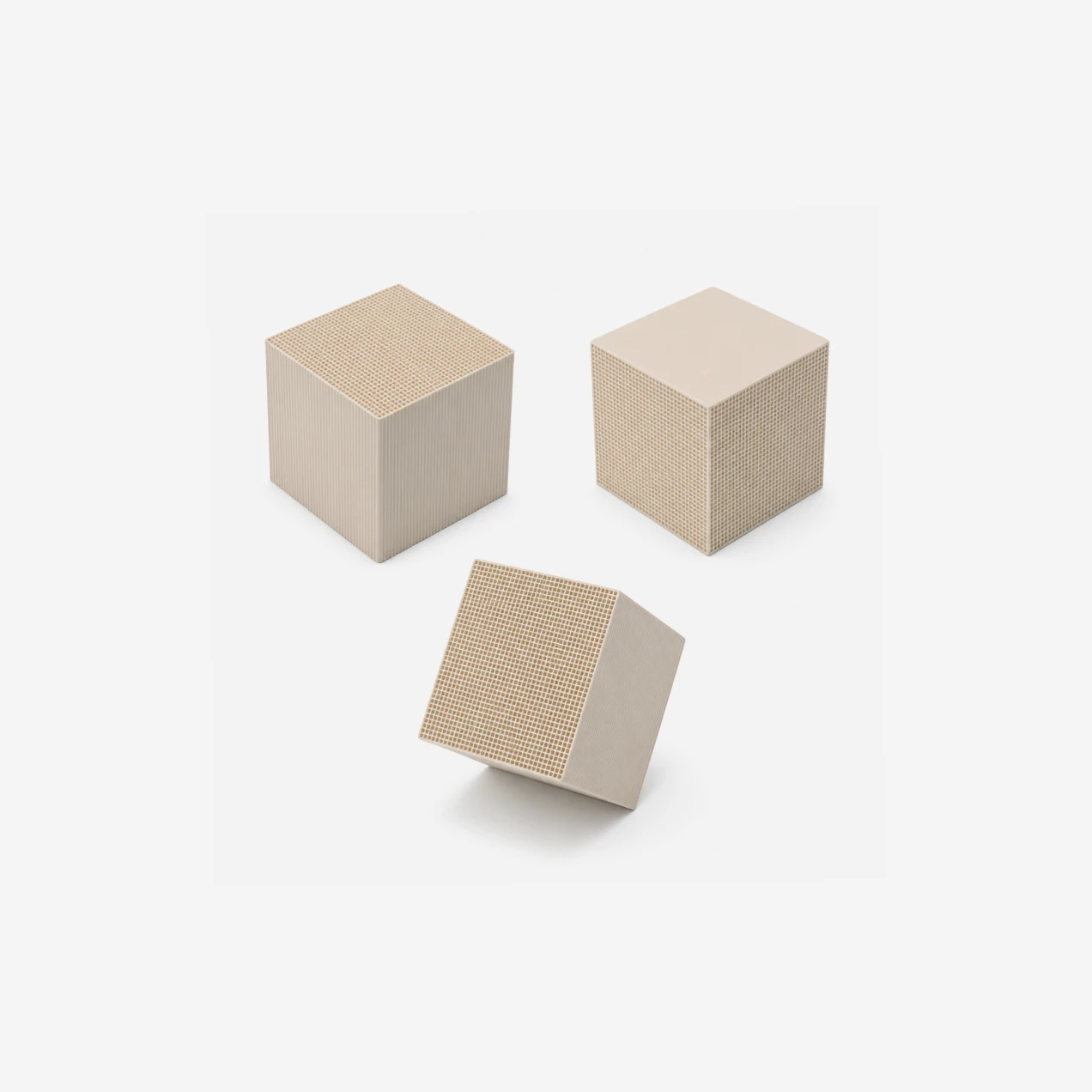
Honeycomb molecular sieve is a molecular sieve built in the form of a honeycomb block rather than loose beads. Crystalline zeolite — the adsorbing material — is combined with a structured ceramic honeycomb carrier, so the finished piece is a solid block shot through with a regular array of straight, parallel channels, their walls carrying the active zeolite. That structure is its whole advantage. Gas flows straight down the open channels with very little resistance, so a honeycomb passes a high flow at a low pressure drop and does not shed dust the way a packed bed of beads can, which makes it well suited to high-flow, continuous and modular gas systems. The zeolite on the walls does the work, selectively adsorbing target molecules from the gas; by choosing the zeolite type — 13X, ZSM-5, Y-type or a SAPO — it can be aimed at moisture, carbon dioxide, VOCs or other specific molecules. It is used in gas drying, purification and catalytic processes. Model RJ-1552.

  • Molecular sieve in honeycomb-block form: zeolite on a structured ceramic honeycomb carrier.
  • Straight, uniform channels: high gas flow, low pressure drop, no dusting.
  • Zeolite type chosen for the target — 13X, ZSM-5, Y-type or SAPO.
  • Adsorbs moisture, CO2, VOCs and other molecules from gas streams.
  • For high-flow gas drying, purification and catalysis; model RJ-1552.

Technial Parameters

ParameterValue
FormHoneycomb block (zeolite on ceramic honeycomb carrier)
Cross-sectionSquare or round
Standard sizes100×100, 150×150, 200×150 mm
Cell density100, 200, 400 CPSI (cells per square inch)
Channel shapesSquare, triangular, hexagonal
Length50–300 mm (customizable)
Zeolite types13X, ZSM-5, Y-type, SAPO-series


PropertyValue
Product TypeHoneycomb (zeolite) molecular sieve
StructureCrystalline zeolite on a structured ceramic honeycomb carrier; straight uniform channels
Model NO.RJ-1552
MaterialZeolite + ceramic honeycomb carrier
Cross-section / SizesSquare or round; 100×100, 150×150, 200×150 mm
Cell Density100, 200, 400 CPSI
Channel ShapesSquare, triangular, hexagonal
Length50–300 mm (customizable)
Zeolite Types13X (CO2, moisture), ZSM-5 (VOCs), Y-type (petrochemical), SAPO (selective)
AdvantagesUniform channels, low airflow resistance, low pressure drop, high flow, no dusting, structurally stable
ApplicationsHigh-flow gas drying, purification, VOC/CO2 removal, catalytic processes; modular systems
TrademarkRONGJIAN
OriginChina
HS Code3824999999 (source; zeolite code 2842100000 may apply, as used for granular sieves — confirm)
Transport PackageSteel drum / ton bag / carton box

Note: the listing’s Basic Info (pellet/ball, 1.7–2.5 / 3.0–5.0 mm) and its diameter/strength parameter table describe a granular molecular sieve and were carried over in error; they do not apply to this honeycomb product, whose form and sizes are as given above.

FAQs

What is a honeycomb molecular sieve, and how is it built?

A honeycomb molecular sieve is a molecular sieve made as a solid honeycomb block instead of the usual loose beads or pellets. It is built in two parts: a structured ceramic honeycomb, a block moulded full of straight, parallel channels, like a bundle of fine square tubes, carries a coating or matrix of crystalline zeolite, which is the material that actually does the adsorbing. So you have a rigid block whose many channel walls are lined with active molecular sieve. In use, the gas to be treated is passed straight through the channels; as it flows along the walls, the zeolite pulls its target molecules, water vapour, carbon dioxide, solvent vapours and the like, out of the stream, and cleaned gas leaves the other end. The point of putting the sieve in this shape rather than in beads is flow: the open, straight channels let a large volume of gas pass with very little resistance, and there are no loose particles to shed dust or pack down. It is, in short, molecular-sieve adsorption in a high-flow, low-resistance, structurally solid form.

Why the honeycomb form — how does it compare to granular molecular sieve?

The zeolite chemistry is the same; the difference is the physical form, and it matters for how the gas flows. A granular or bead molecular sieve is poured into a vessel as a packed bed, and the gas has to worm its way through the twisting gaps between countless particles, which works, but costs pressure, and the particles rub and shed a little dust and can settle and pack down over time. A honeycomb replaces that random maze with a set of straight, uniform, parallel channels. The gas runs cleanly down them, so the resistance to flow, the pressure drop, is far lower for the same throughput, and there is no bed of particles to dust or compact. That makes the honeycomb the better choice wherever the gas flow is high or continuous, where a low pressure drop saves real energy, and in modular or rotor systems that need a rigid, self-supporting block rather than a loose fill. The trade is that a honeycomb holds somewhat less adsorbent per unit volume than a dense packed bed, so for low-flow batch drying where pressure drop hardly matters, beads can still be more economical. Tell us your gas flow and target and we will advise the form.

Which zeolite type — 13X, ZSM-5, Y-type or SAPO?

The honeycomb can be made with different zeolites, and the type is chosen for what you need to remove, because each zeolite has its own pore size and affinity. 13X is the broad workhorse: with its large pores it adsorbs water and carbon dioxide strongly, so it is the choice for gas drying and CO2 removal. ZSM-5 has a medium pore tuned to organic molecules, which makes it the type for capturing VOCs, solvent and hydrocarbon vapours, from air and process gas. Y-type zeolite is used mainly in petrochemical work, where it serves as an adsorbent and catalyst in feedstock processing. And the SAPO series offers medium pore sizes with selective adsorption, useful where a particular molecule must be picked out from a mix. In practice you tell us the molecule to be removed, moisture, CO2, a named solvent, or something more specific, and we match the zeolite to it; a honeycomb can even combine types for a mixed duty. Tell us the target molecule and the gas and we will specify the zeolite.

What sizes and cell densities does it come in, and where is it used?

The blocks are made to a set of standard shapes and sizes and can be tailored. The cross-section is square or round, in standard footprints of 100 by 100, 150 by 150 and 200 by 150 millimetres, and the length runs from 50 up to 300 millimetres, cut to what the housing needs; larger duties are built up by stacking blocks. The fineness of the honeycomb is set by its cell density, given in CPSI, cells per square inch, with 100, 200 and 400 CPSI the usual grades: a higher cell count means finer channels, more wall surface and more adsorption but a little more resistance, so the grade is chosen to balance capacity against pressure drop. The channels themselves can be square, triangular or hexagonal. As for where it goes, it suits high-flow, continuous gas work: drying compressed air and process gas, purifying and removing carbon dioxide, capturing VOCs from exhaust and process streams, and acting as a catalyst support, especially in modular units and rotary concentrators that need a rigid, low-resistance block. Send us the flow, the target and the housing and we will specify the block and the cell density.

A honeycomb molecular sieve is a molecular sieve in the form of a ceramic honeycomb block, its many straight channel walls carrying crystalline zeolite. Gas passes straight down the open channels, so it treats a high flow at a low pressure drop and sheds no dust, unlike a packed bed of beads — which makes it the form of choice for high-flow, continuous and modular gas systems. The zeolite on the walls adsorbs the target molecules, and it is chosen for the job.

Choosing the zeolite type:

ZeoliteAdsorbs / does
13XWater and CO2 — gas drying and CO2 removal
ZSM-5VOCs and organic vapours
Y-typePetrochemical feedstock adsorption and catalysis
SAPO-seriesSelective adsorption at a medium pore size

The blocks are square or round, in sizes of 100×100, 150×150 and 200×150 mm and lengths of 50 to 300 mm, in cell densities of 100, 200 and 400 CPSI with square, triangular or hexagonal channels. They are used in gas drying, purification, VOC and CO2 removal and catalytic processes, especially high-flow and modular systems. Tell us your gas, flow and target molecule, and we will specify the zeolite, the size and the cell density.