
If random packing is the heap of loose rings and saddles you tip into a column, structured packing is its ordered cousin — neat blocks of corrugated sheets that stack together like a honeycomb. You will see it called out on distillation and air-separation columns, usually with a code like 250Y, and it can look like a black box. It is not. This post explains what structured packing is, how it works, the main types, what those numbers mean, and when it is the right choice. For the loose kind, see our companion post on random tower packing types.
What is structured packing?
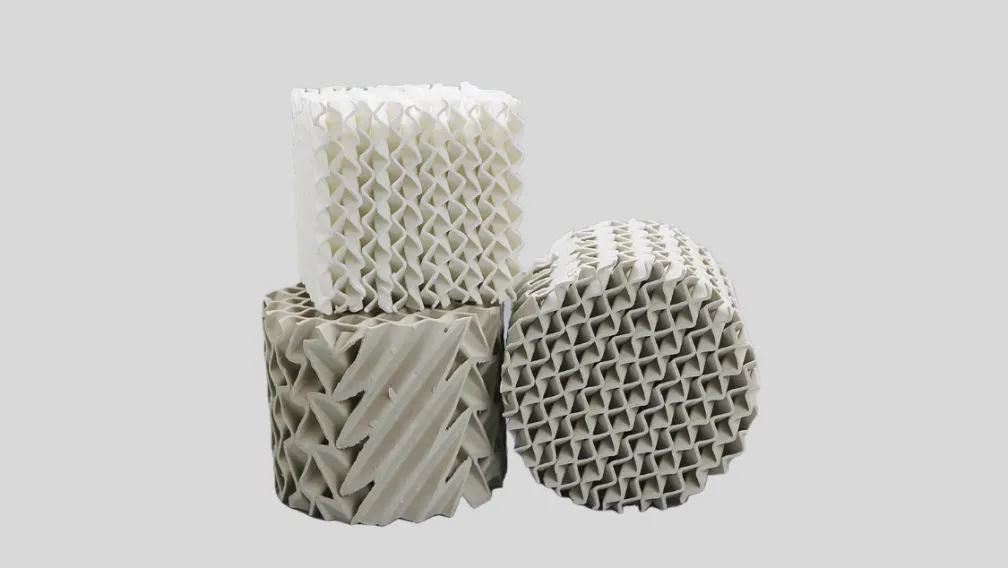
Structured packing is a mass-transfer packing made of thin corrugated sheets — of metal, plastic or woven wire gauze — stacked in a fixed, ordered pattern to form an open honeycomb of inclined channels. Placed in a distillation or absorption column, it forces the rising gas and falling liquid along criss-crossing paths that bring them into close contact over a large surface, while leaving the structure very open so the gas meets little resistance. It was introduced by the Swiss firm Sulzer at the end of the 1970s — the corrugated metal Mellapak was the first of its kind — and it became the standard for high-efficiency and low-pressure-drop columns through the 1980s. The key idea is order: because the geometry is fixed and uniform, the liquid spreads evenly and the flow does not wander, which is what makes structured packing so efficient.
How structured packing works
A block of structured packing is built from many parallel corrugated sheets set on edge, with the corrugations running at an angle. Neighbouring sheets are turned so their channels cross, and each layer in the column is rotated about ninety degrees from the one below it. That arrangement does three things. The liquid, fed evenly onto the top, runs down the sheet faces as a thin film and is constantly split and remixed where the channels cross, so it wets the whole surface instead of channelling. The gas rises through the open, inclined channels, meeting that wetted film over a very large area but with little to obstruct it. And because the sheets present so much surface in such an open structure, the packing gives a high separation efficiency at a very low pressure drop. Manufacturers also texture or perforate the sheet surface so that even poorly-wetting liquids spread across it, which lifts performance further.
Reading the numbers: surface area and corrugation angle
The codes on structured packing describe its geometry, and once you can read them the packing stops being mysterious. The number is the specific surface area, and the letter is the corrugation angle.
| Notation | What it means |
|---|---|
| The number (125, 250, 350, 500) | The specific surface area in m²/m³ — a higher number means more efficiency, but lower capacity and a higher pressure drop |
| Y | A corrugation angle of 45° to the vertical — the standard, balanced choice |
| X | A corrugation angle of 60° — steeper channels, so higher capacity but lower efficiency |
So a 250Y packing has 250 square metres of surface per cubic metre and a 45-degree corrugation, while a 500Y has twice the surface — more separating power in the same height, but less capacity and more pressure drop. Specific surface areas across the range run from roughly 50 up to 750 square metres per cubic metre. As a rule, a higher number and the Y angle are chosen for efficiency and purity, and a lower number or the X angle for capacity and throughput.
The main types of structured packing
Structured packing comes in a few distinct forms, and the construction sets what each is good for.
| Type | How it is built | Best for |
|---|---|---|
| Corrugated sheet metal | Thin perforated or embossed metal sheets, crimped and stacked | The versatile workhorse — vacuum to medium-pressure distillation and absorption |
| Wire gauze | Corrugated woven wire mesh | Deep vacuum and very low liquid rates — the lowest pressure drop per stage |
| Grid | Thick, smooth metal | Fouling and high-capacity duty, and heat transfer — it resists clogging |
| Plastic | Corrugated PP, PVC or PVDF sheet or mesh | Corrosive, lower-temperature absorption and scrubbing |
Corrugated sheet-metal packing is the common, economical form, made in a wide range of surface areas and angles, and it handles the widest span of duties. Wire gauze packing, woven from fine mesh, wets by capillary action and gives the lowest pressure drop of all, which is why it is used for deep-vacuum and low-liquid-rate distillation where every millibar counts, though it is costly and dislikes fouling. Grid packing is made of thicker, smoother metal for services that would clog a fine packing — dirty or high-capacity duty and heat transfer — trading some efficiency for ruggedness. Plastic structured packing, in PP, PVC or PVDF, brings corrosion resistance to absorption and scrubbing at lower temperatures.
Advantages and limitations
Structured packing is chosen for good reasons, and it has clear limits.
Advantages:
- High separation efficiency — more theoretical stages in a given height, so a shorter column, or a sharper separation.
- Very low pressure drop, which saves energy and suits vacuum service, where it keeps the reboiler cool and protects heat-sensitive products.
- Even liquid distribution and high capacity, letting a column process more in the same shell — which is why it is a favourite for revamps.
Limitations:
- Higher cost than random packing, and more care needed in manufacture and installation.
- It depends on clean, well-distributed liquid; a poor distributor throws away its efficiency.
- The fine types foul easily and are hard to clean in place, so they are a poor fit for dirty service.
Structured or random packing?
The two are complementary. Structured packing wins where efficiency, low pressure drop and capacity matter most — vacuum and high-purity distillation, air separation, and getting more out of an existing column. Random packing wins where the service is dirty or fouling-prone, the budget is tight, or conditions swing, because it tolerates all three. Deciding between them for a specific column is the job we walk through in our guide to selecting tower packing; either way, a good liquid distributor and the right supports matter as much as the packing you pick.
Where structured packing is used
Structured packing turns up wherever a clean, efficient separation is wanted at low pressure drop. In distillation it is the standard for vacuum columns, for high-purity and close-boiling separations, and for revamps that need more capacity or better efficiency from the existing tower. Air separation plants use it heavily, as do refineries in atmospheric and vacuum distillation. In absorption it serves in CO2 and hydrogen-sulfide absorbers and strippers, natural-gas drying, and similar gas-treating duties, especially where a low pressure drop cuts the running cost. Where the stream is dirty or laden with solids, though, random packing or trays are the better call.
Where Rongjian fits
We manufacture structured packing in metal, ceramic and plastic — corrugated sheet, wire gauze and plastic forms across the usual surface-area range — alongside our random packing and the tower internals that make either type perform. We supply distillation, absorption and air-separation plants in many countries. If you are choosing between structured and random packing, or sizing a structured bed and its distributor, tell us the service — the separation, the flows, the pressure and the chemistry — and we will recommend the packing and back it with data. Reach out through the enquiry form or contact your Rongjian representative for advice or a quotation.
Frequently asked questions
What is structured packing?
Structured packing is a mass-transfer packing made of thin corrugated sheets of metal, plastic or wire gauze, stacked in a fixed, ordered honeycomb of inclined channels. In a distillation or absorption column it forces gas and liquid along crossing paths that give a large contact surface at a very low pressure drop, and its uniform geometry spreads the liquid evenly for high efficiency.
How does structured packing work?
Liquid fed onto the top runs down the corrugated sheets as a thin film and is repeatedly split and remixed where the channels cross, so it wets the whole surface. Gas rises through the open inclined channels, meeting that film over a large area with little resistance. The ordered geometry avoids channelling and wall flow, which is what gives structured packing its high efficiency and low pressure drop.
What does 250Y mean?
The number is the specific surface area in square metres per cubic metre, so 250Y has 250 m²/m³. The letter is the corrugation angle to the vertical: Y is 45 degrees, the standard balance, and X is 60 degrees, which gives more capacity but lower efficiency. A higher number, such as 500, means more surface and efficiency but less capacity.
Is structured or random packing better?
Neither is better outright. Structured packing gives higher efficiency and a lower pressure drop, so it suits vacuum, high-purity and high-capacity work; random packing tolerates fouling and upsets and costs less, so it suits dirty or variable service on a budget. The right choice depends on the column’s duty.
What is wire gauze structured packing?
Wire gauze packing is a structured packing woven from fine metal mesh and then corrugated. The mesh wets by capillary action even at very low liquid rates, and it gives the lowest pressure drop per theoretical stage of any packing, which makes it the choice for deep-vacuum and fine-chemical distillation. It is more expensive than sheet-metal packing and is not suited to fouling service.
When should you use structured packing?
Use it when you need high efficiency, a low pressure drop, or high capacity — vacuum distillation, high-purity or close-boiling separations, air separation, gas absorption, and revamps that must get more out of an existing column. Avoid it on dirty or fouling streams, where random packing or trays cope better.
-

Rongjian
Process Media Manufacturer Since 2010
Rongjian produces tower packing, molecular sieves, ceramic grinding media and other process media from our Pingxiang production base. We supply to industrial projects in over 100 countries.