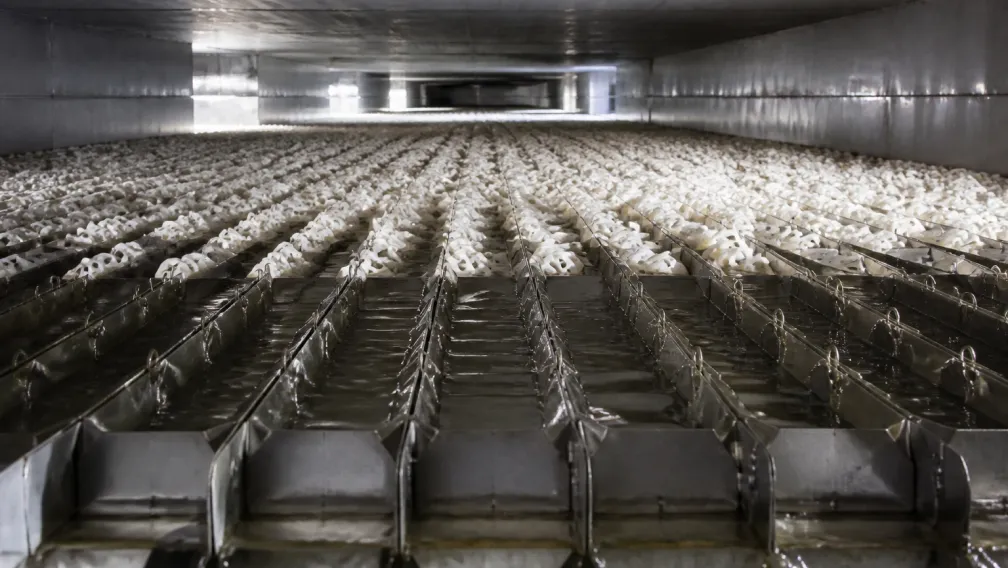

Tower packing is a bed of engineered media placed inside a vertical column to bring gas and liquid into close contact. The packing itself takes no part in the reaction or separation. Its job is to provide a large, continuously renewed surface where the two phases can exchange mass and heat as they flow past each other. Packed columns built on this simple principle handle distillation, absorption, scrubbing, stripping, and direct-contact cooling across the chemical, petrochemical, refining, and environmental industries. This guide explains how a packed column works, the two main packing families, how ceramic, plastic, and metal materials differ, and what matters when selecting a packing for a given duty.
How a Packed Column Works
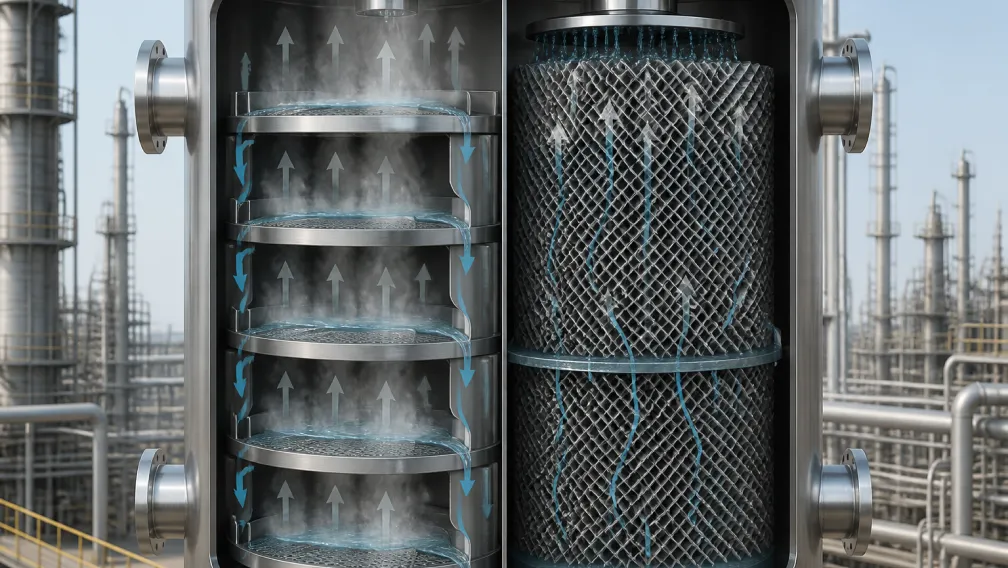
A packed column is a vertical shell filled with one or more beds of packing. Liquid enters at the top through a distributor and flows downward as a thin film over the packing surface. Gas enters below the bed and flows upward through the open voids between the packing pieces. The two phases move counter-currently, and every component that is more soluble, more condensable, or more reactive in the liquid phase transfers across the film.
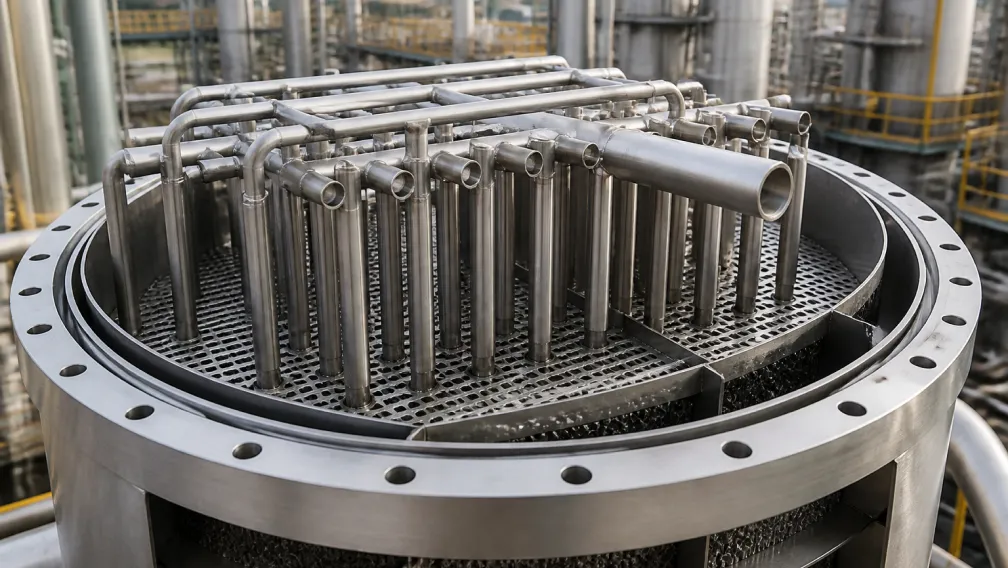
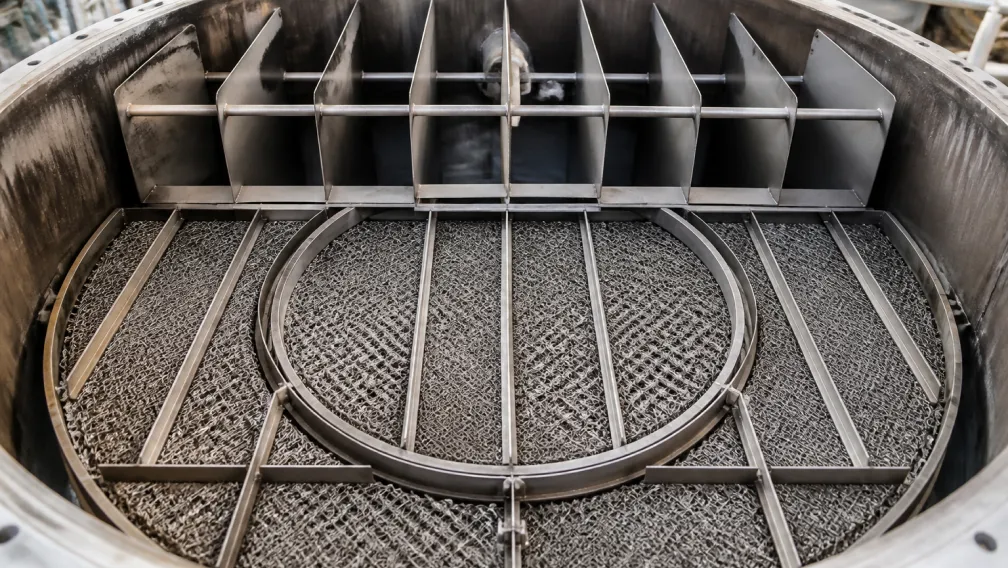
Three design details decide how well this works. First is surface area: commercial packings provide roughly 60 to over 1,000 square meters of contact area per cubic meter of bed. Second is wetting: the liquid must spread evenly, so the quality of the tower internals—especially the liquid distributor, support plate, and hold-down grid—matters as much as the packing itself. Third is bed depth: maldistribution grows with depth, so tall beds are split into sections of about 6 meters with redistribution between them.
The efficiency of a packed bed is expressed as HETP, the Height Equivalent to a Theoretical Plate. It states how much bed height delivers one equilibrium stage of separation. Typical commercial packings run from about 150 mm to 700 mm HETP, and the value drives the total packed height—and with it the column cost.
The Two Families of Tower Packing
All commercial tower packing belongs to one of two families: random packing or structured packing.
Random Packing
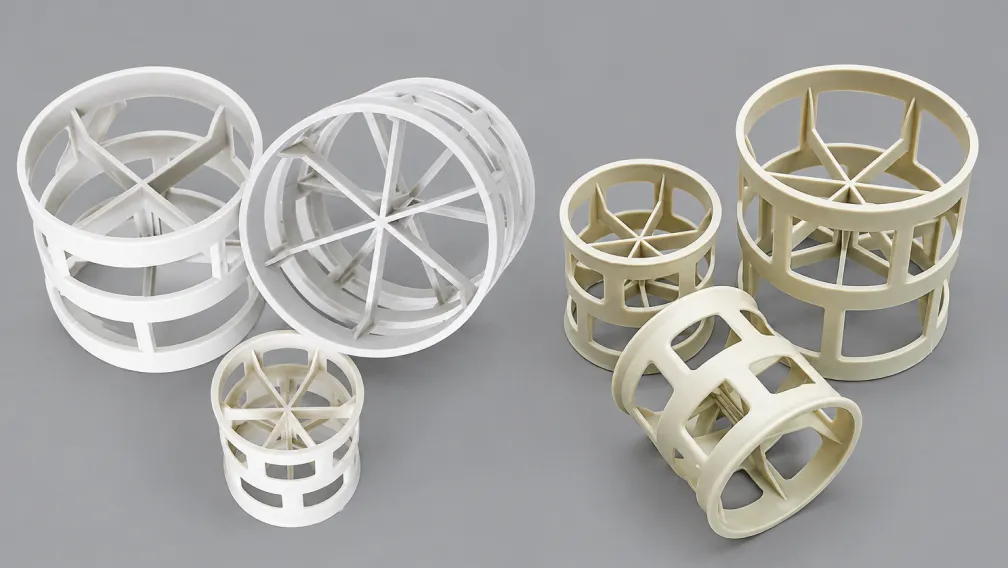
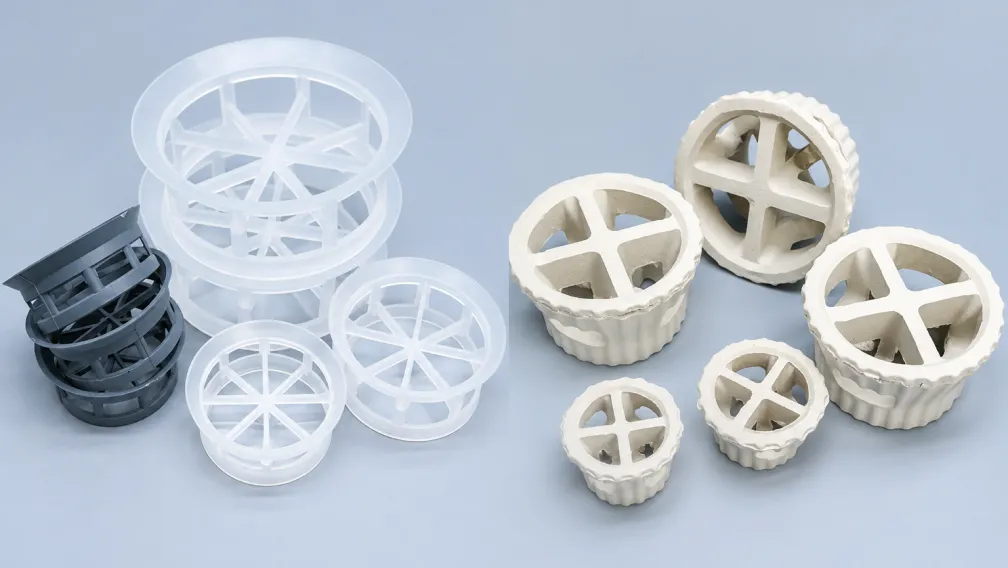
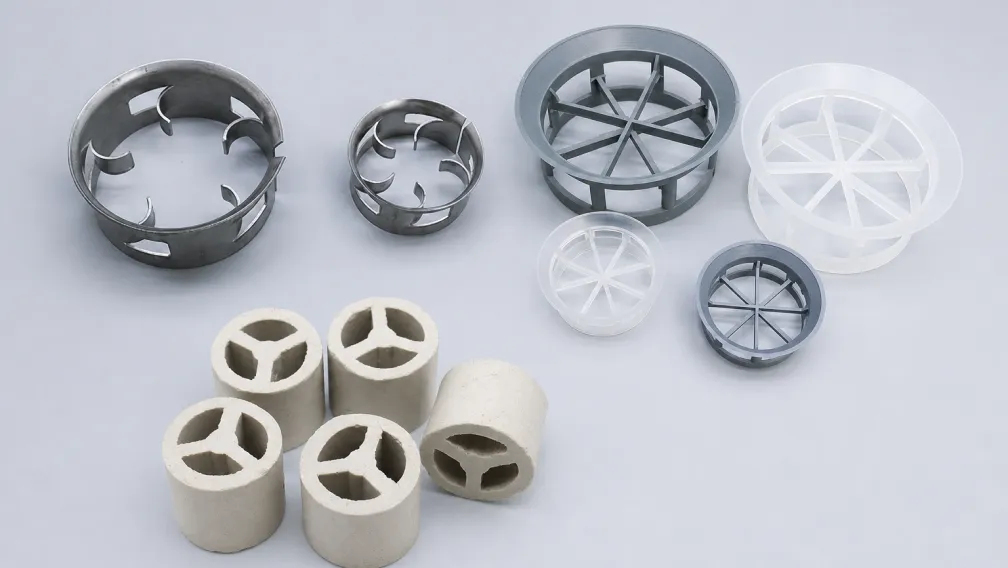
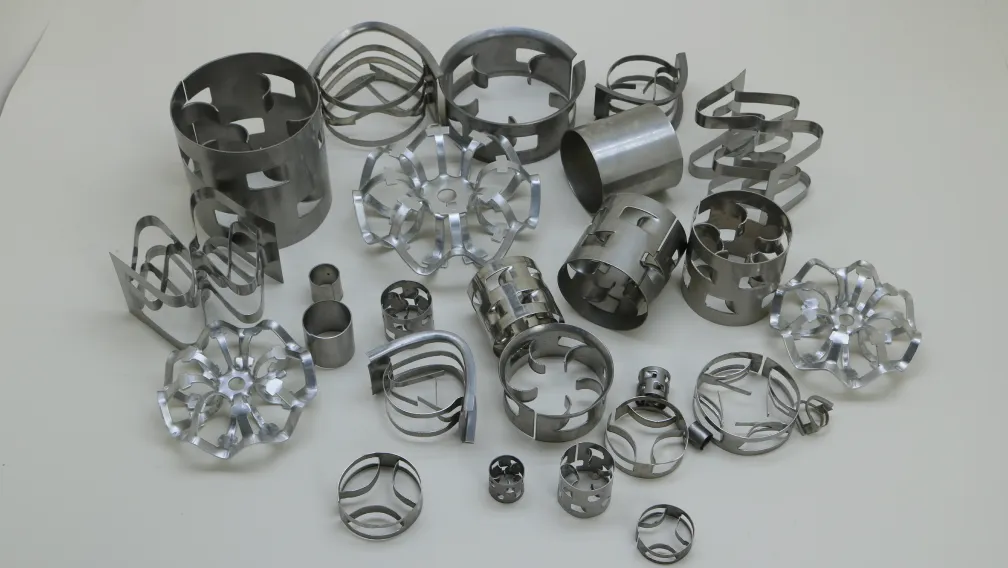
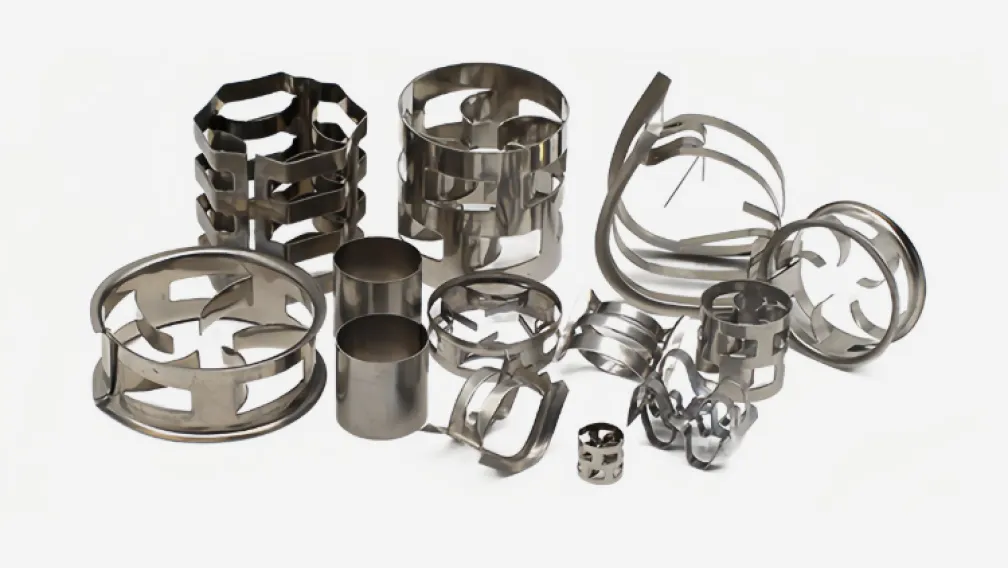
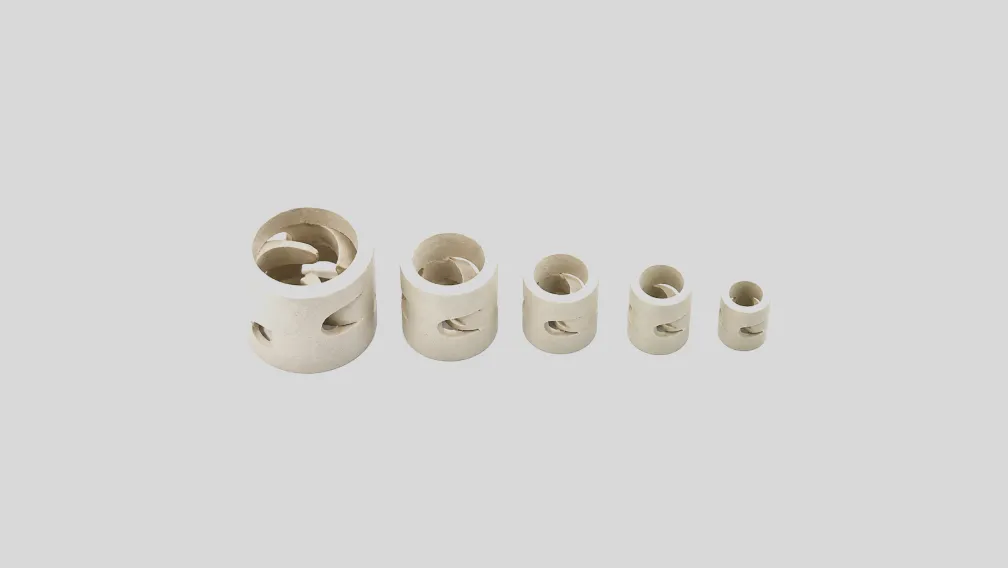
Random packing consists of individual preformed pieces—rings, saddles, and similar shapes—dumped into the column, where they settle into a disordered bed. Raschig rings were the first industrial design, introduced in 1914. Modern equivalents such as Pall rings, Intalox saddles, and cascade mini rings deliver far better efficiency and capacity through open geometries with internal tongues and windows. Random packing is inexpensive, tolerant of fouling, and simple to install and replace. Our guide to random tower packing types covers the main designs in detail.
Structured Packing
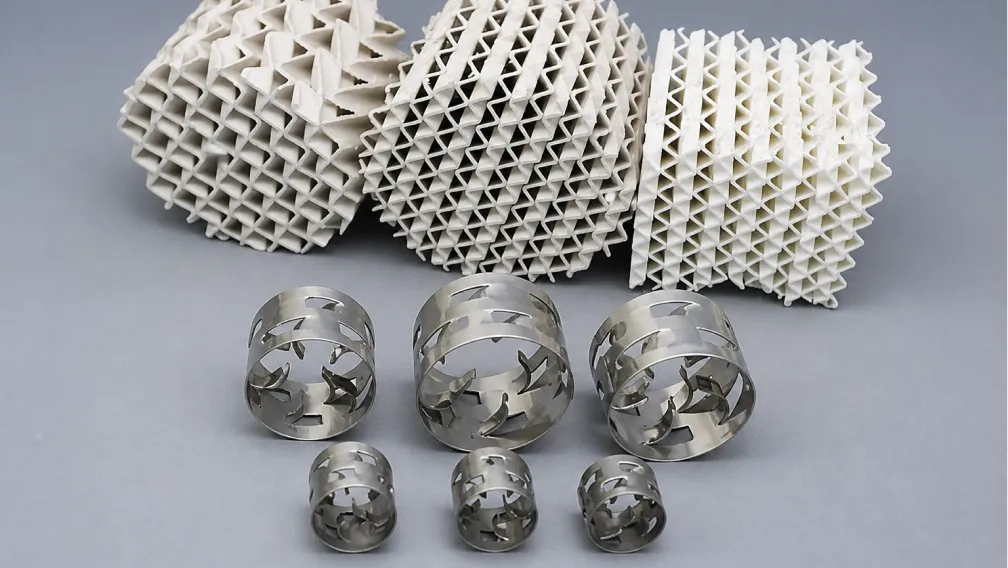
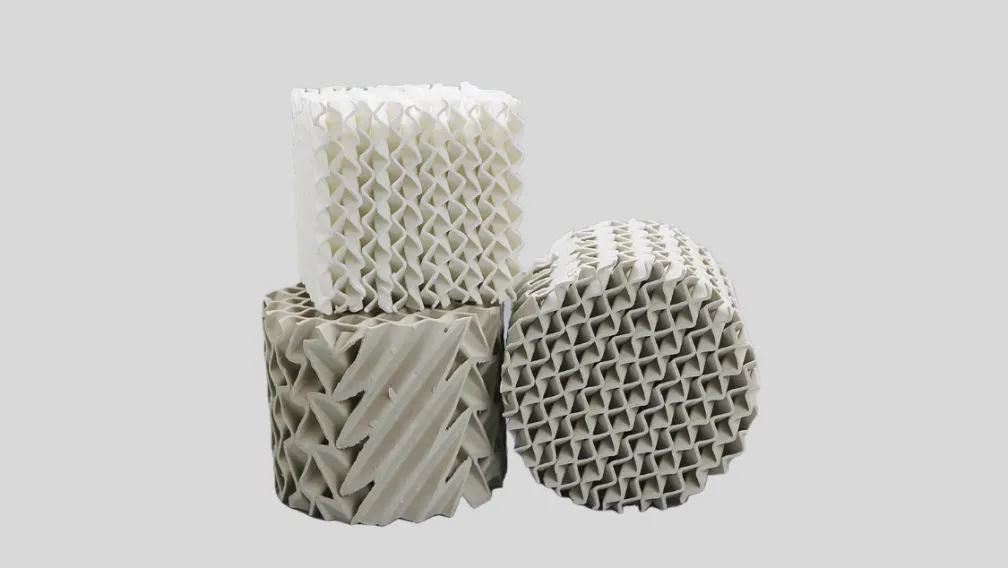
Structured packing is fabricated from corrugated sheets, perforated plates, or wire gauze assembled into uniform modules with fixed flow channels. The ordered geometry cuts pressure drop to roughly a third of a comparable random bed and reaches HETP values of 150 to 400 mm, making it the standard choice for vacuum distillation and difficult, close-boiling separations. The construction and grades are explained in our article on what structured packing is.
For a full side-by-side evaluation—pressure drop, capacity, liquid load limits, fouling behavior, and cost—see our dedicated comparison of random packing vs structured packing.
Tower Packing Materials: Ceramic, Plastic, and Metal
Geometry sets the hydraulic performance of a packing. Material decides where it can survive. Both families are available in three material classes.
Ceramic Packing
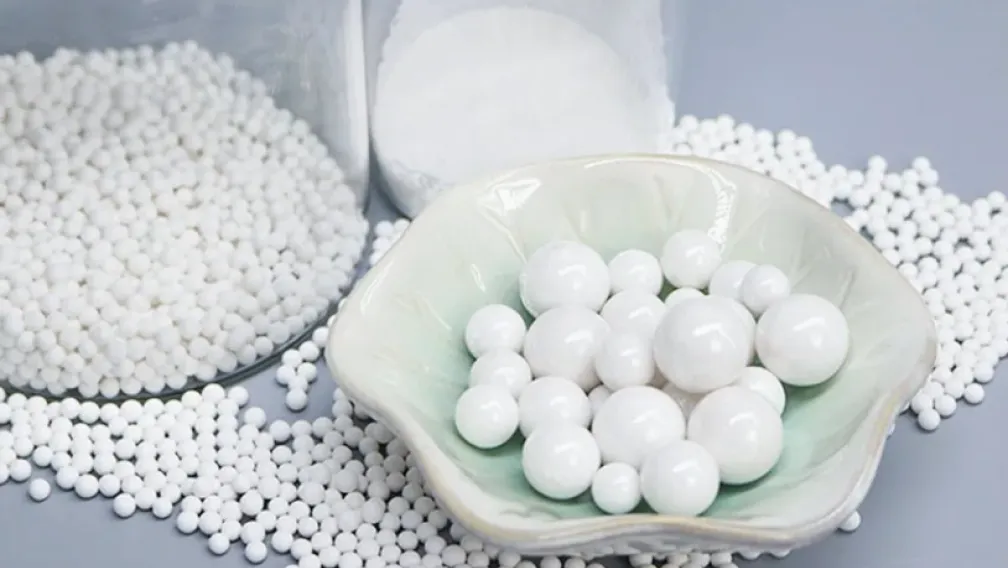
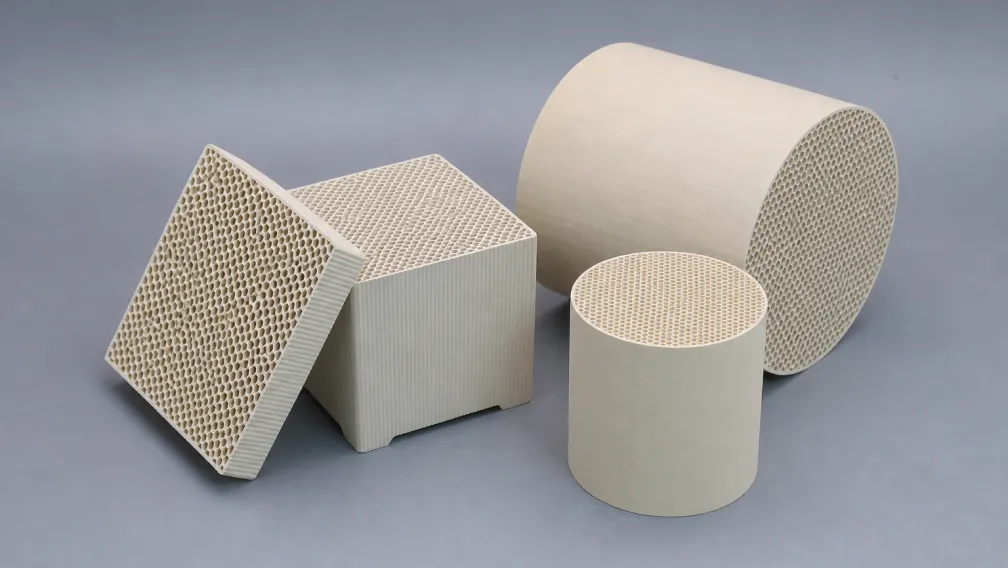
Ceramic packing, usually porcelain or high-alumina bodies, withstands temperatures above 1,000 °C and resists virtually all inorganic acids and most organic media. The two exceptions are hydrofluoric acid and hot concentrated caustic. Its limits are brittleness and weight. Classic duties include sulfuric acid drying towers and other strongly corrosive, high-temperature services, where pieces such as the ceramic Raschig ring remain in daily use worldwide.
Plastic Packing
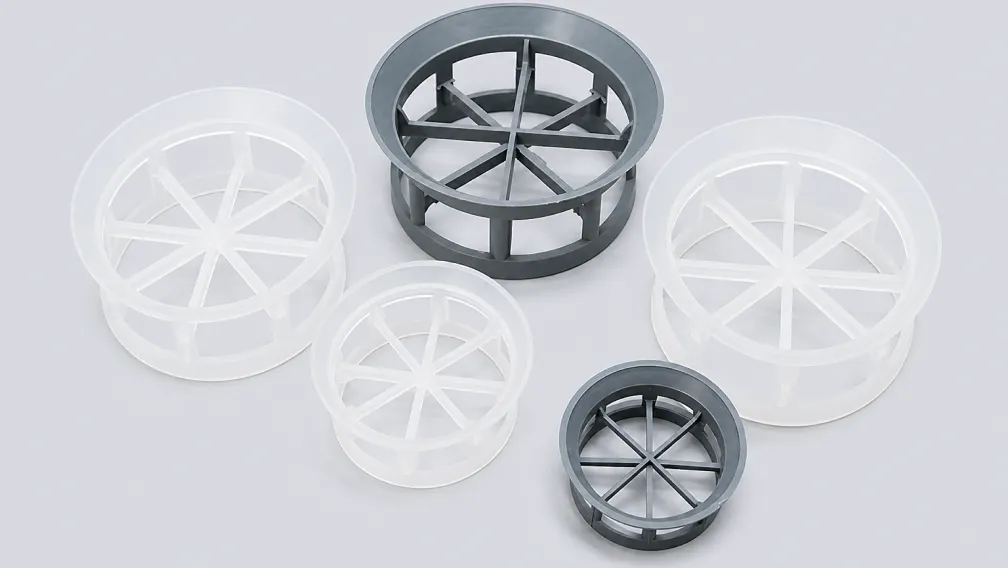
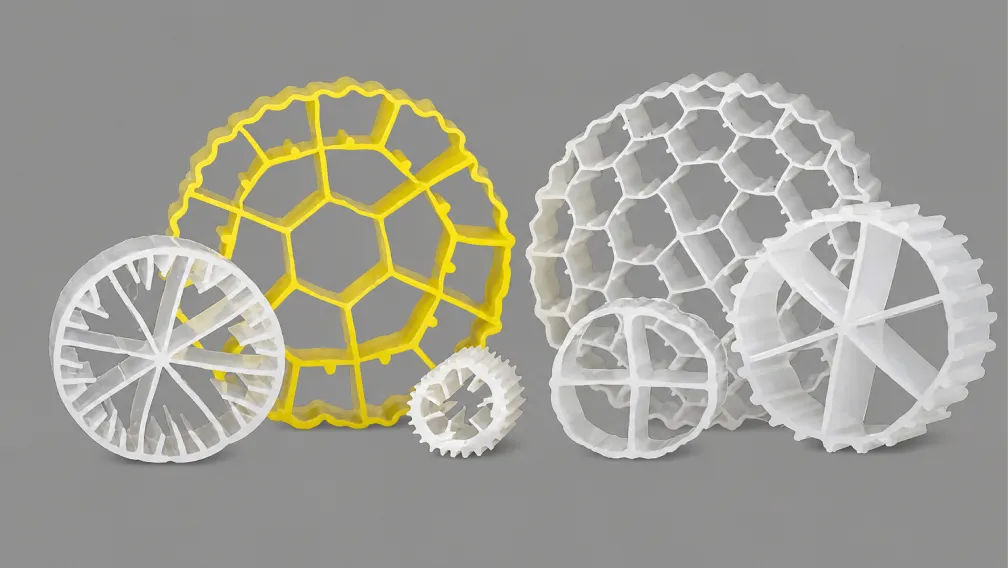
Plastic packing combines low weight, low cost, and broad corrosion resistance in aqueous systems. Temperature sets the ceiling: polypropylene runs to about 90 °C, CPVC to roughly 100 °C, PVDF to about 150 °C, and PTFE or PFA to 260 °C. Scrubbers, cooling towers, and wastewater stripping columns are typical applications, and the PP Pall ring is the mos t widely specified piece in this class.
Metal Packing
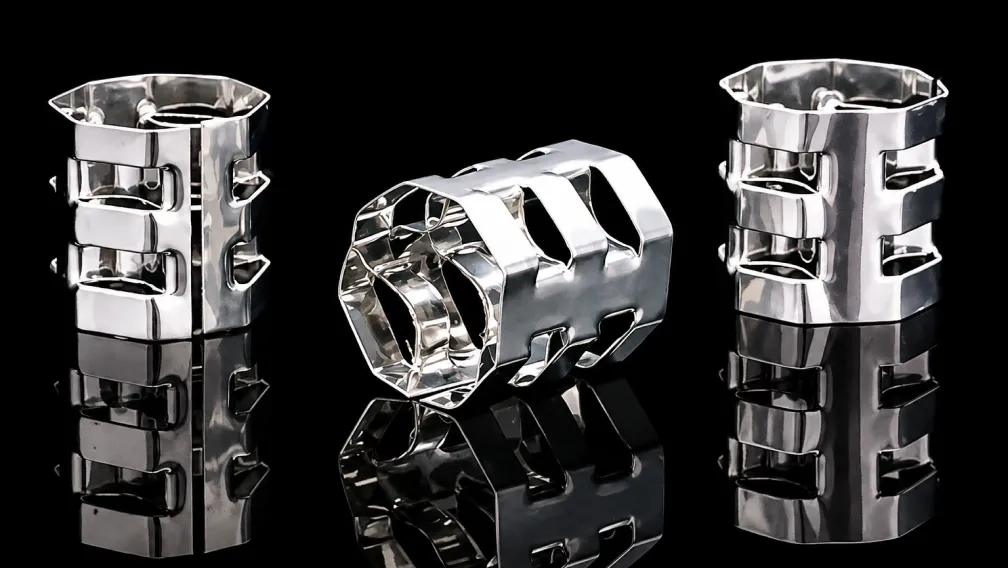
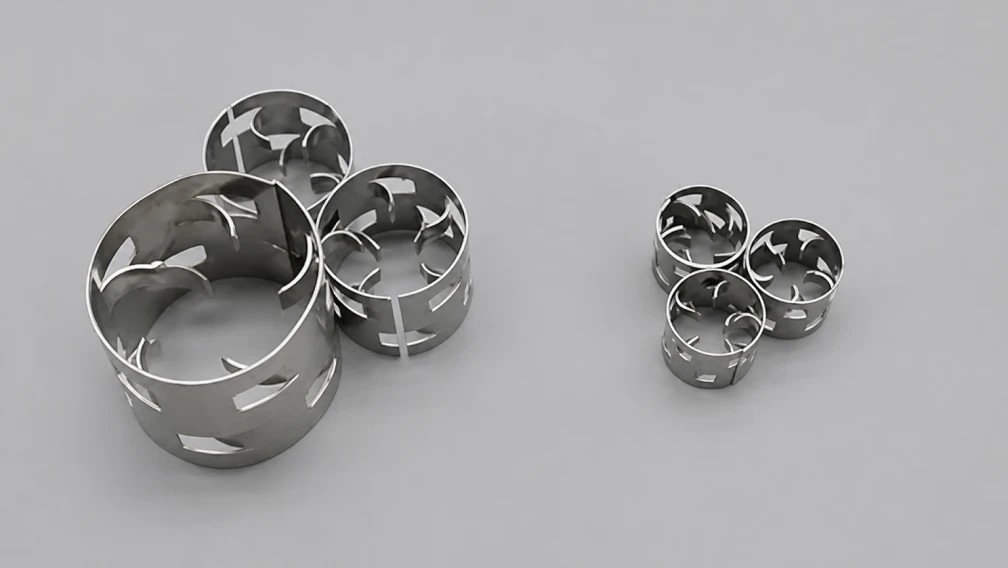
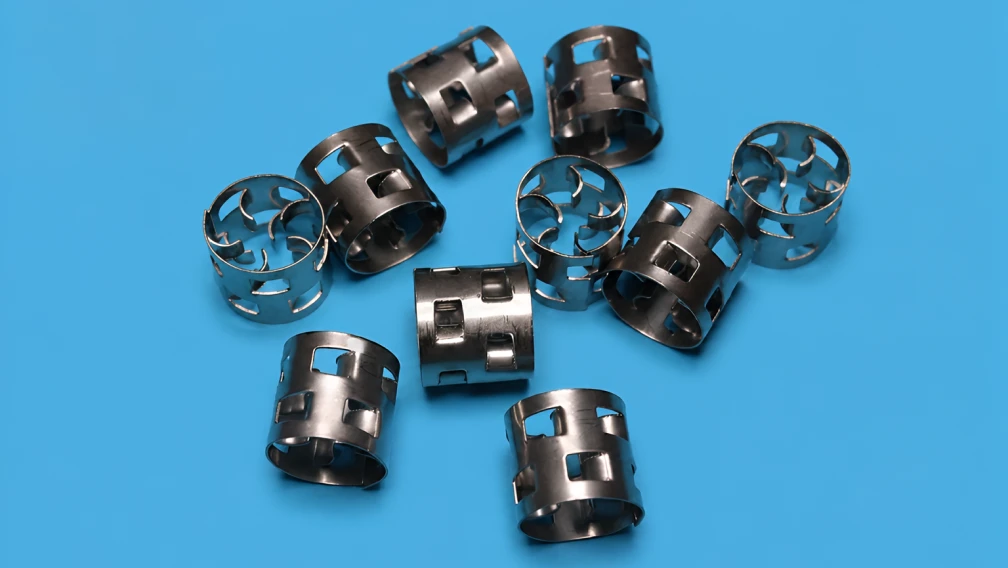
Metal packing in carbon steel, 304 and 316L stainless steel, or special alloys offers the highest mechanical strength and temperature capability, with thin walls that maximize free volume and capacity. It dominates refinery and petrochemical distillation. The metal Pall ring is the benchmark design; where  pressure drop and efficiency are critical, metal structured packing takes over.
| Material | Max service temperature | Corrosion behavior | Typical services |
|---|---|---|---|
| Ceramic (porcelain, high alumina) | >1,000 °C | Resists most acids; attacked by HF and hot concentrated caustic | Acid drying towers, high-temperature corrosive duty |
| Plastic (PP, CPVC, PVDF, PTFE) | 90–260 °C by resin | Excellent in aqueous and many chemical systems | Scrubbers, strippers, cooling and wastewater towers |
| Metal (CS, SS304/316L, alloys) | High, alloy-dependent | Good where corrosion allowance or alloy suits the medium | Refinery and petrochemical distillation, gas treating |
Packing Size: The Efficiency and Pressure Drop Trade-Off
Within any design, smaller pieces pack more surface area into each cubic meter and deliver a lower HETP. The cost is higher pressure drop, lower capacity before flooding, and greater sensitivity to fouling. A 16 mm Pall ring can nearly halve the HETP of a 50 mm ring, but it roughly doubles the pressure drop per meter. Two practical rules follow. Keep the column-to-packing diameter ratio at or above about 8 to 10 so wall channeling stays under control. And size up when the feed carries solids, polymerizes, or scales—the lost efficiency is cheaper than repeated shutdowns for cleaning. In new designs, most engineers start with a mid-size packing—38 to 50 mm for random beds—and adjust only after the hydraulic rating shows pressure drop and capacity margin. Chasing the lowest HETP on paper is a common way to build a column that floods early and plugs often.
Where Tower Packing Is Used
The same hardware serves four core operations:
- Distillation. Separating liquid mixtures by volatility, from crude and aromatic splits in refineries to solvent recovery in fine chemicals.
- Absorption and scrubbing. Removing components from a gas stream with a solvent or reagent—CO2 in amine units, SO2 and HCl in flue gas scrubbers, and moisture in sulfuric acid drying towers.
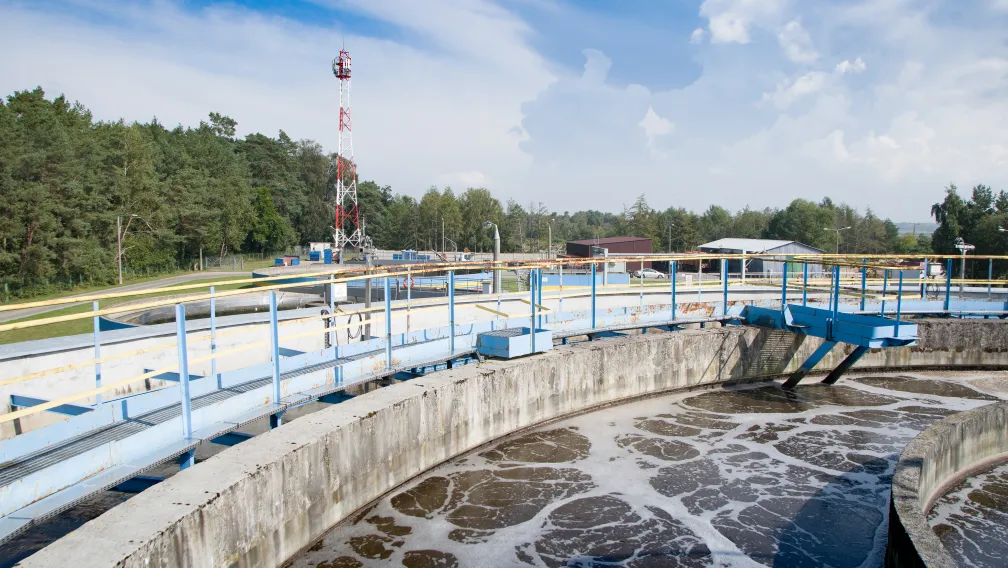
- Stripping. Driving dissolved gases or volatile compounds out of a liquid, such as ammonia stripping and VOC removal in water treatment.
- Direct-contact heat transfer. Cooling or quenching hot gases and condensing vapors where indirect exchangers would foul.
Service Life and Replacement
Tower packing is a long-life component. In clean, stable service, metal and ceramic beds routinely operate for ten years or more, and ceramic pieces in acid towers often outlast the vessel lining around them. The common causes of early replacement are mechanical rather than chemical: crushing from overloaded support plates, attrition in high-velocity beds, plugging from fouling or precipitation, and thermal shock during upset conditions. Plastic beds also age under sustained temperature near their resin limit, losing strength and deforming under load.
Replacement is straightforward with random packing—the bed is emptied through the manway and new pieces are dumped in. Structured packing takes more planning, since modules must be cut to pass the manway and reassembled inside. Either way, a packing change is one of the few revamp jobs that can raise column capacity or product purity without touching the shell, which is why packing upgrades remain the most common low-cost debottlenecking measure in older plants.
A Brief Note on Packing vs Trays
Trays remain the other standard contacting device, and the comparison deserves its own article. In short, packed columns win in vacuum service, corrosive duty, foaming systems, and small-to-moderate diameters, because pressure drop is low and exotic packing materials are cheap. Trays hold the advantage in very large diameters, dirty services that need mechanical cleaning access, and duties with extreme liquid rates.
Choosing between random and structured packing, fixing the material and size, and matching the internals to the bed are decisions best made against actual process data. Send us your operating pressure, gas and liquid rates, and separation target, and our engineers will return a hydraulic sizing with a recommended packing type, material, and bed arrangement. Contact us for a proposal, or review our tower packing range to see available designs and materials.
-

Rongjian
Process Media Manufacturer Since 2010
Rongjian produces tower packing, molecular sieves, ceramic grinding media and other process media from our Pingxiang production base. We supply to industrial projects in over 100 countries.