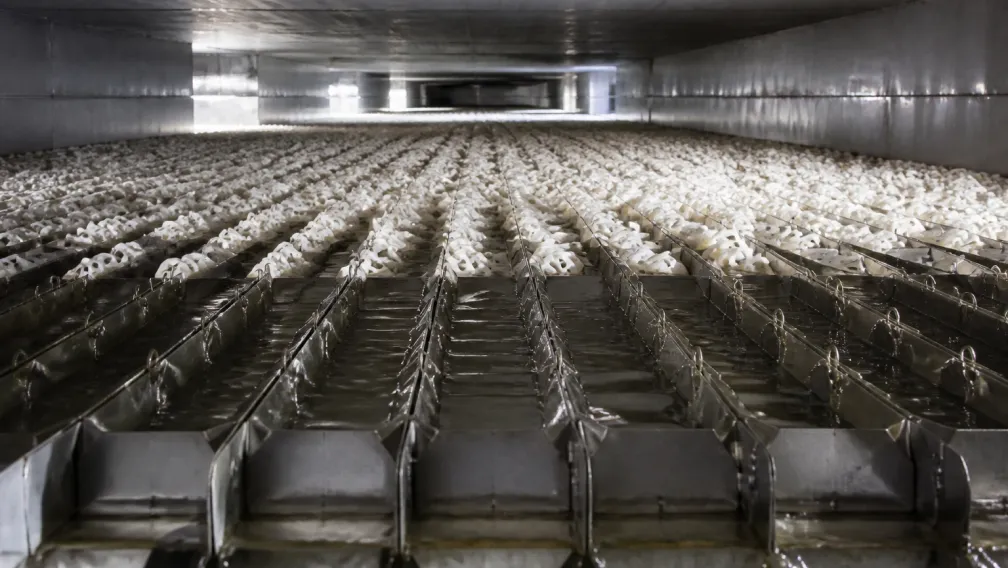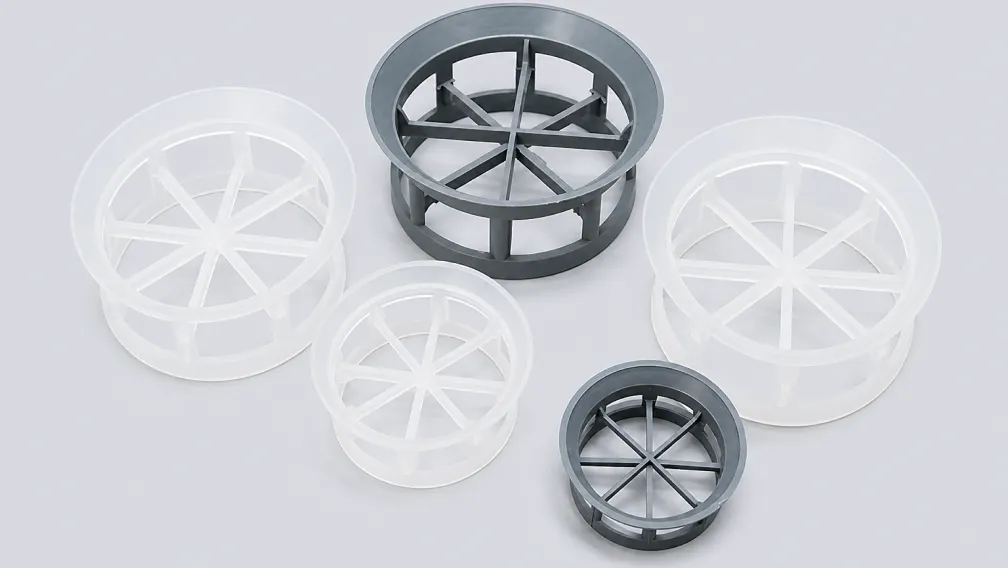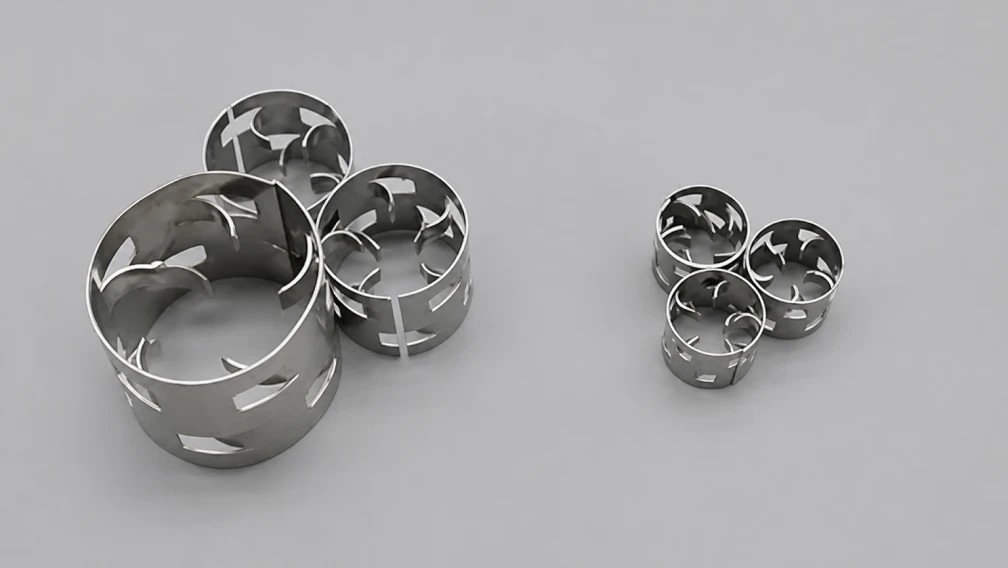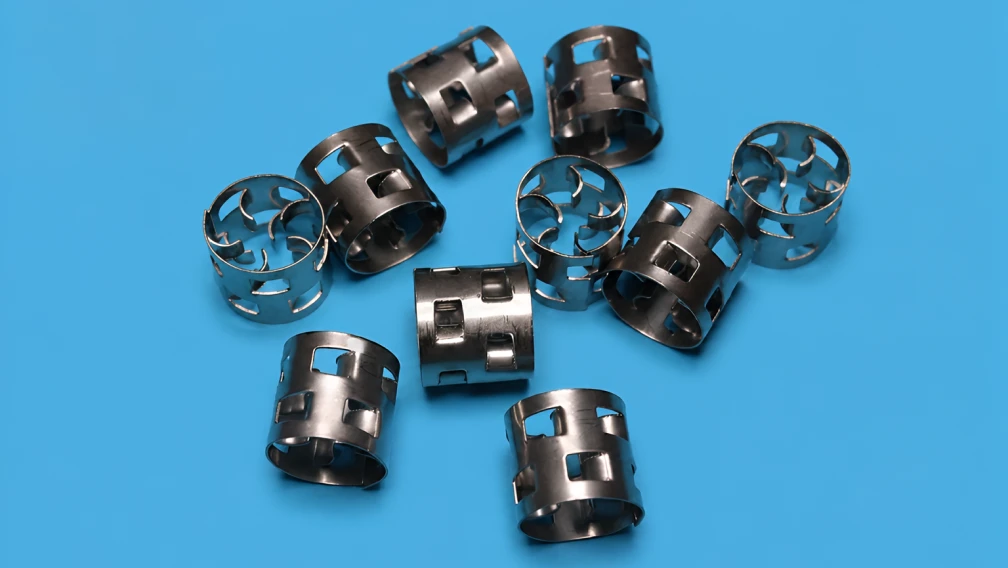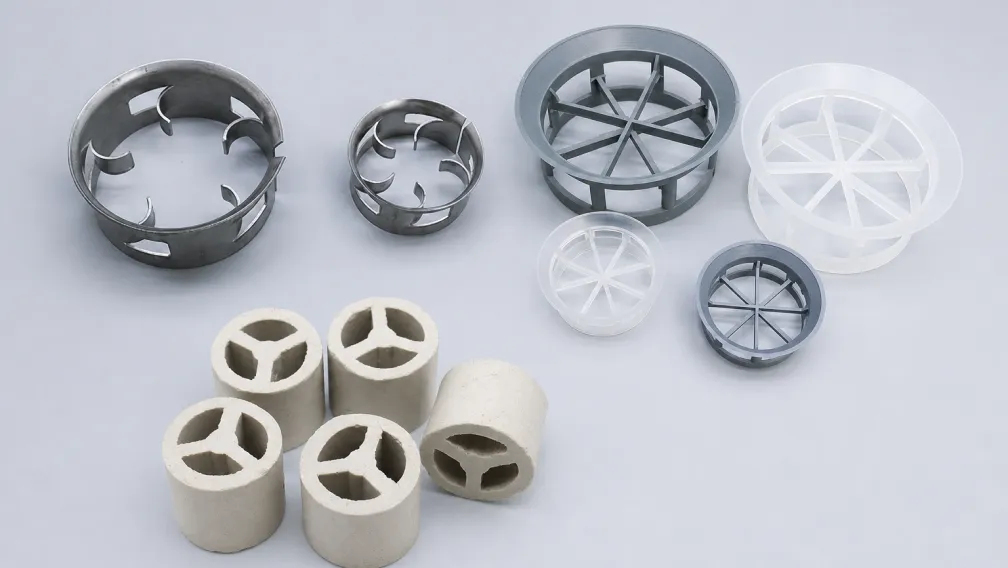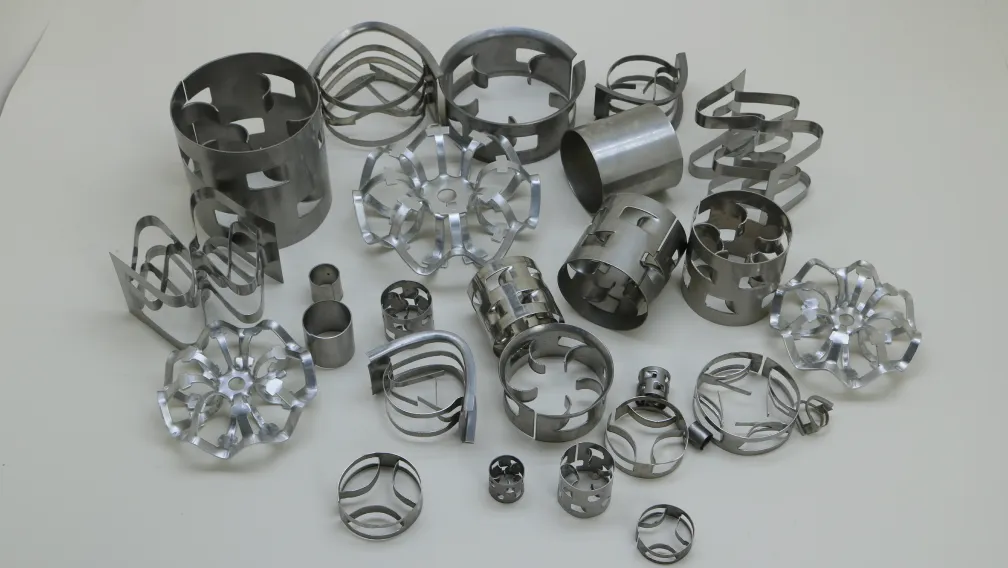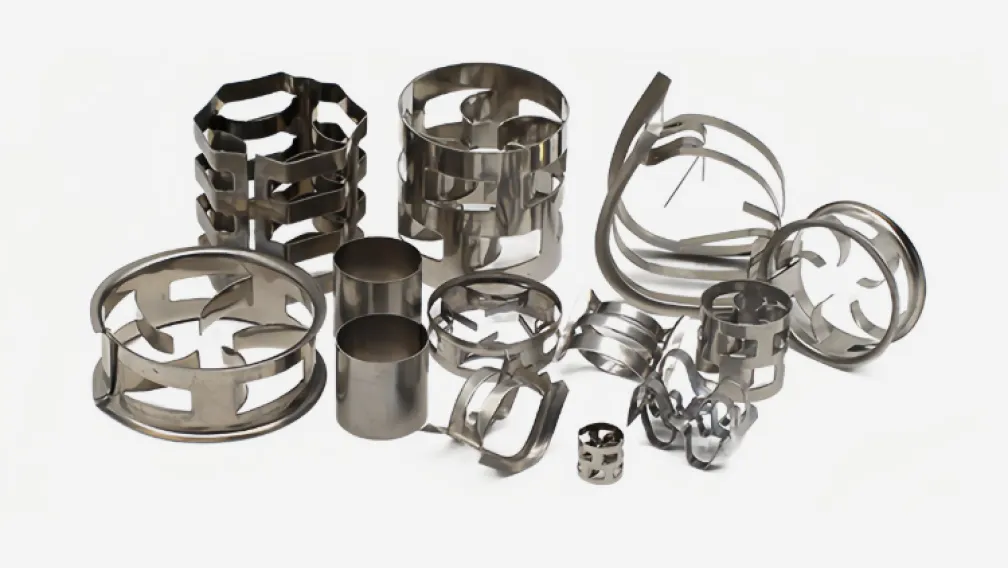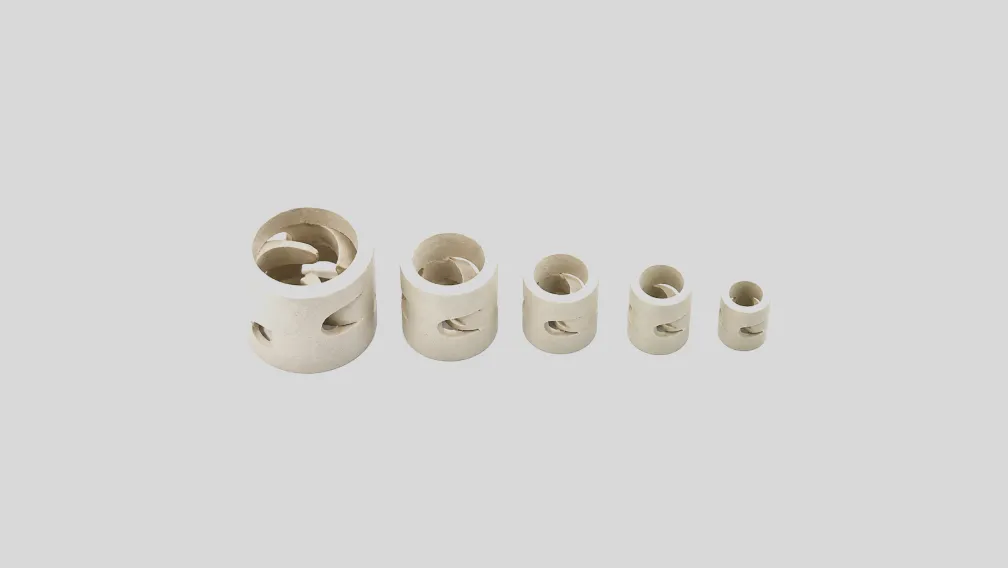

Pour a bag of random packing out on the floor and it looks like a heap of odd little rings and saddles. Look closer and each shape is the answer to a problem someone spent years solving. Random packing — the loose pieces that fill a distillation or absorption column — comes in dozens of designs, and the names pile up fast: Raschig, Pall, cascade, Intalox, Berl, super rings. This post sorts them into families, tells the story of how they grew out of one another, and explains what actually sets each apart. If you are picking packing for a specific column, that is a separate job we cover in our guide to selecting tower packing; here the aim is simply to understand what all these shapes are.
What random packing is, and why the shape matters
Random packing is a mass of small inert shapes tipped loose into a column to make wetted surface, the place where rising vapour and falling liquid meet and exchange components. A good packing shape is chasing three things at once: a large surface for the two phases to contact on, a high void fraction so gas passes with little resistance, and an even spread of liquid with no dry patches or channels. It is also trying to avoid one thing — nesting, where pieces stack neatly inside each other and block off the flow. The whole history of random packing is the story of shapes getting better at all four. That history falls into three generations.
Three generations of random packing
Random packing has evolved in three clear steps, and knowing which generation a shape belongs to tells you most of what you need about how it performs.
| Generation | Era | Shapes | What changed |
|---|---|---|---|
| First | about 1907–1950s | Raschig ring, Lessing ring, Berl saddle | Simple closed shapes; efficiency fell away in columns much over half a metre wide |
| Second | about 1950s–1970s | Pall ring, Intalox saddle | The walls were opened up — more capacity, higher efficiency, lower pressure drop |
| Third | about late 1970s–1980s | Cascade mini ring, super and high-flow rings, high-performance saddles | Most of the wall removed — the highest capacity and the lowest pressure drop |
The first generation began in 1907, when Friedrich Raschig introduced the Raschig ring — a plain ceramic tube — the first packing designed on purpose rather than scavenged from broken pottery and coke. It worked, but the simple closed shapes of this era, the Raschig and Lessing rings and the Berl saddle, spread liquid poorly, so their efficiency dropped off in any column much wider than half a metre. The second generation, led by the Pall ring that BASF developed in the 1950s, fixed this by cutting windows in the ring wall so the inside of each piece joined the flow; capacity and efficiency rose and the pressure drop fell. The third generation, from the late 1970s on, pushed the idea to its limit by removing as much of the closed wall as possible — the cascade mini rings, super rings and high-performance saddles that dominate new towers today.
The ring family
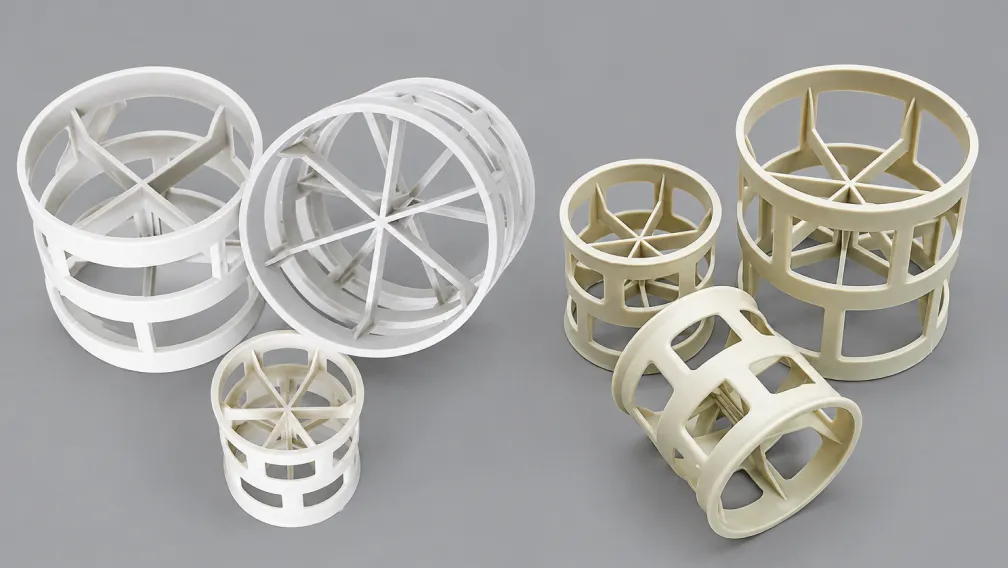
Raschig rings are where it all starts: a hollow cylinder as tall as it is wide. They are cheap and strong, but their closed wall gives a modest surface, a higher pressure drop and uneven distribution, so you rarely see them in a new tower — though they still turn up as bed support and in simple duties. Lessing rings are the same cylinder with a single internal partition added to help spread the liquid, a small step up from the plain Raschig.
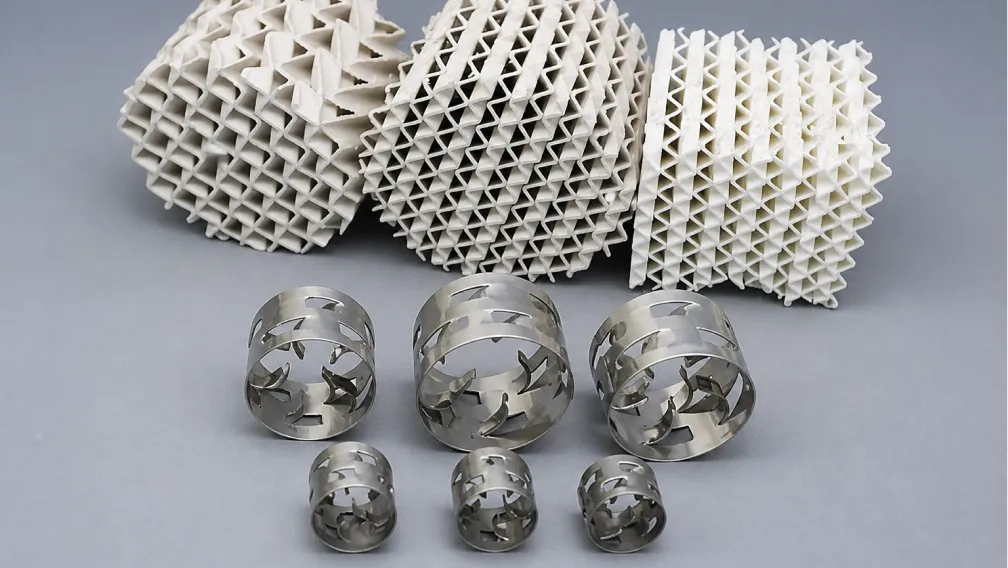
Pall rings are the shape that changed everything. Take a Raschig ring, punch rows of windows in the wall and bend the little tongues inward, and gas and liquid can now flow through the ring from any direction instead of only around it. A Pall ring has the same surface area as a Raschig ring of the same size, but it uses that surface far better, so it carries 50 percent or more extra vapour at the same pressure drop and runs at about half the resistance. Made in metal, plastic and ceramic, the Pall ring is still the everyday workhorse of distillation and absorption.
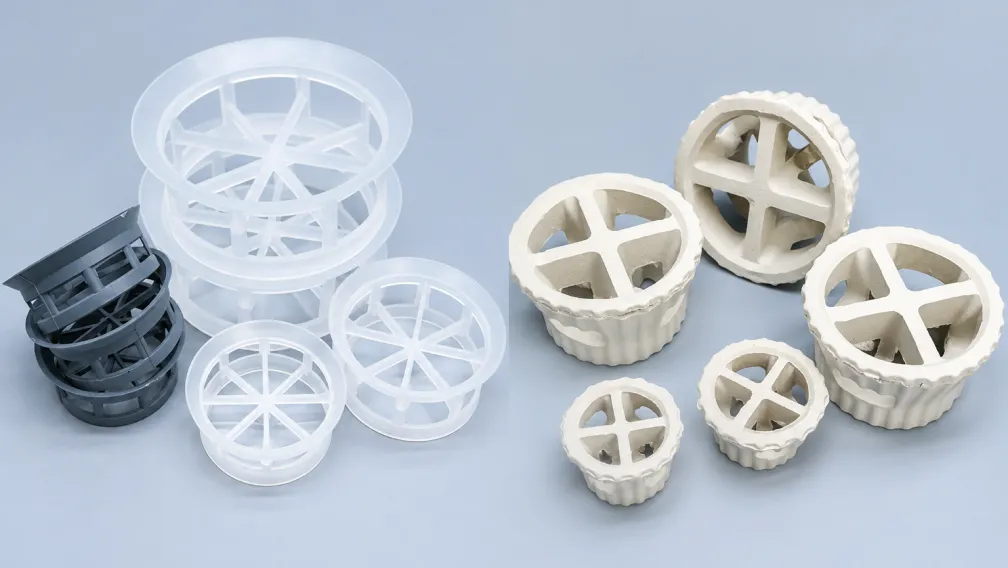
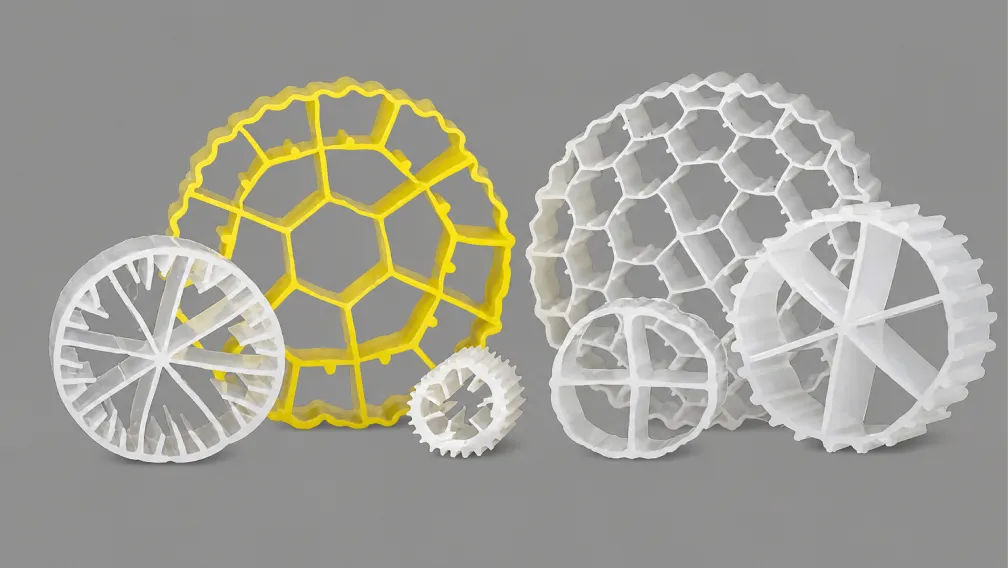
Cascade mini rings are the refined, third-generation ring: short — only about half as tall as they are wide — with a flared collar around one edge. Being short and collared, they cannot nest, so they settle into an open, even bed that gives a higher capacity and a lower pressure drop than a Pall ring. Super and high-flow rings take the same logic further still, with almost no closed wall, for the highest capacity and the lowest resistance of any random packing.
The saddle family
Saddles solve the distribution problem from a different angle. Instead of a ring, they are curved, saddle-shaped pieces, and their open form spreads liquid smoothly and drains well. Berl saddles were the original, introduced in the 1930s; they distribute liquid well but tend to nest together, which cost them ground over time. Intalox saddles are the improved version: their arc-shaped channels give a low resistance to gas and an even liquid spread, and their shape is designed so the pieces cannot lock tightly together. A saddle is typically longer than it is wide, which is what tells them apart from rings at a glance. High-performance saddles, a saddle-and-ring hybrid, add ring-like capacity to the saddle’s even distribution and are used in demanding distillation and acid-gas service.
Rings and saddles at a glance
| Packing | Family | Key feature | Typical use |
|---|---|---|---|
| Raschig ring | Ring (1st gen) | Plain hollow cylinder, height equal to diameter | The original; low-cost, low duty; rare in new towers |
| Lessing ring | Ring (1st gen) | A Raschig ring with an internal partition | Slightly better liquid spread than a Raschig |
| Pall ring | Ring (2nd gen) | Windows in the wall with tongues bent inward | Distillation and absorption; the everyday workhorse |
| Cascade mini ring | Ring (3rd gen) | Short ring (about ½ the diameter tall) with a flared collar | High capacity and low pressure drop |
| Super / high-flow ring | Ring (3rd gen) | Wall almost entirely open | Highest capacity, lowest pressure drop |
| Berl saddle | Saddle (1st gen) | The original saddle shape | Early saddle packing; tends to nest |
| Intalox saddle | Saddle (2nd gen) | Arc-shaped channels that resist nesting | Even liquid spread; acids, drying and absorption |
| High-performance saddle (IMTP-type) | Saddle/ring hybrid (3rd gen) | Open saddle-and-ring shape | High capacity with even distribution |
The broad difference between the two families is simple: rings, especially Pall and cascade types, promote turbulence and mixing and hold up well against fouling because they drain freely; saddles give a more uniform liquid spread. Which one suits a given tower depends on the duty, which is exactly the judgement our selection guide walks through.
The same shape in three materials
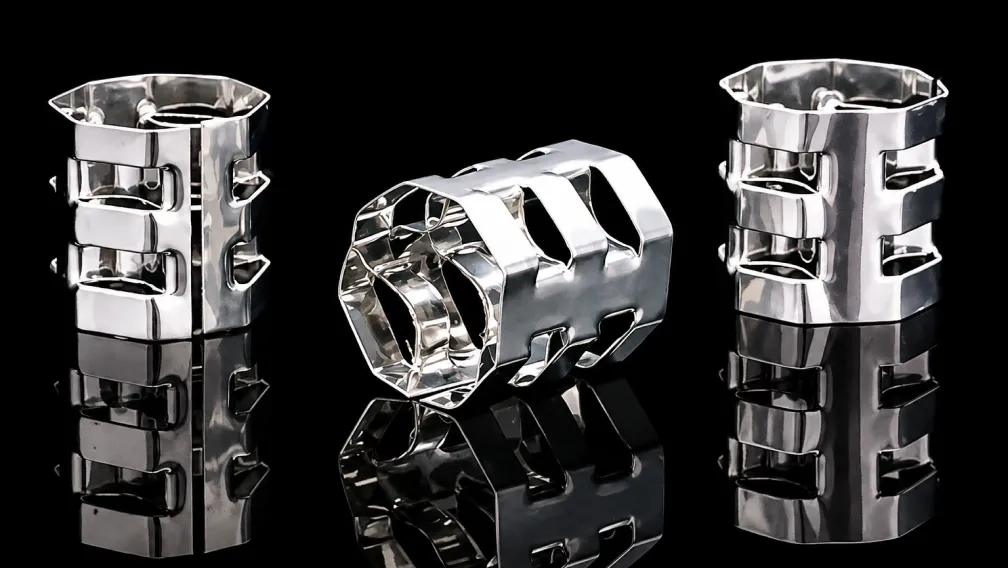
Nearly every ring and saddle is made in three materials, and the choice sets the packing’s temperature range, chemical resistance and strength rather than its hydraulic behaviour. Metal packing — stainless steel, carbon steel and higher alloys — is the strongest and thinnest-walled, so it gives the most open bed and stands high temperature and pressure. Ceramic packing resists strong acids and alkalis (bar hydrofluoric acid) and shrugs off heat, which is why it fills sulfuric-acid and other corrosive, hot towers, though it is brittle. Plastic packing in PP, PVC or PTFE is light, cheap and chemically resistant, and suits scrubbing and lower-temperature absorption. So a Pall ring, for instance, comes as a metal Pall ring, a ceramic Pall ring or a plastic Pall ring, each for a different environment, and the same is true across the ring and saddle families.
Where Rongjian fits
We manufacture the full random packing range described here — Raschig rings, Pall rings, cascade mini rings, Intalox and Berl saddles, and the high-performance rings and saddles — in metal, ceramic and plastic, along with the tower internals that go with them. If you are weighing up which shape, material and size your column needs, tell us the service — the process, the flows, the temperature and the chemistry — and we will point you to the right packing and back it with data. Reach out through the enquiry form or contact your Rongjian representative for advice or a quotation.
Frequently asked questions
What is a Raschig ring?
A Raschig ring is the original random packing: a simple hollow cylinder, as tall as it is wide, introduced by Friedrich Raschig in 1907. It is cheap and strong but has a fairly closed wall, so it gives a modest surface, a higher pressure drop and uneven liquid distribution. Newer rings have largely replaced it in modern towers, though it still appears in simple duties and as bed support.
What is the difference between a Raschig ring and a Pall ring?
A Pall ring is a Raschig ring with windows cut into the wall and tabs bent inward. That opens the inside of the ring to the flow, so although the two have the same surface area at the same size, the Pall ring uses it far better — carrying 50 percent or more extra vapour at the same pressure drop, at about half the resistance. In practice the Pall ring separates and absorbs more efficiently, which is why it replaced the Raschig ring as the standard.
What is a cascade mini ring?
A cascade mini ring is a refined, third-generation ring: short, only about half as tall as it is wide, with a flared collar around one edge. Because it is short and collared it cannot nest inside its neighbours, so the bed sits open and even, giving a higher capacity and a lower pressure drop than a Pall ring of the same size. It is essentially an improved Pall ring.
Pall ring or saddle packing — which is better?
Neither is better outright; they do different things. Pall rings promote turbulent mixing, are mechanically strong and resist fouling because they drain freely, which suits most distillation and absorption. Saddles, such as Intalox saddles, give a more uniform liquid spread and low gas resistance, which helps where even wetting matters. The right choice depends on the tower’s duty.
What are the three generations of random packing?
The first generation (from 1907) is the simple closed shapes — Raschig and Lessing rings and Berl saddles. The second (from the 1950s) opened the walls, giving the Pall ring and the Intalox saddle. The third (from the late 1970s) removed most of the wall for the highest capacity and lowest pressure drop, giving cascade mini rings, super rings and high-performance saddles.
What material should random packing be made from?
It depends on the chemistry and temperature. Metal packing is the strongest and most open, for high temperature and pressure. Ceramic resists strong acids, alkalis and heat, so it suits corrosive hot towers such as sulfuric-acid service. Plastic is light, cheap and chemically resistant, for scrubbing and lower-temperature absorption. Most ring and saddle shapes are available in all three.
-

Rongjian
Process Media Manufacturer Since 2010
Rongjian produces tower packing, molecular sieves, ceramic grinding media and other process media from our Pingxiang production base. We supply to industrial projects in over 100 countries.