
Ultra-fine wet milling and mechanical dispersion in stirred media mills rely entirely on the precise selection of ceramic grinding media. Whether processing electronic ceramics, battery precursor slurries, high-purity pigments, or advanced coatings, the physical characteristics of the grinding beads dictate energy consumption, mill throughput, and final product purity. Inefficient bead sizing or mismatched slurry viscosities lead to severe media wear, screen blinding, and broad particle size distributions. This guide details the fundamental hydrodynamics of wet bead milling, the 10-100 geometric sizing rule, slurry rheology optimization, and the critical parameters governing media wear rates in continuous industrial mills.
Hydrodynamics of Stirred Media Mills
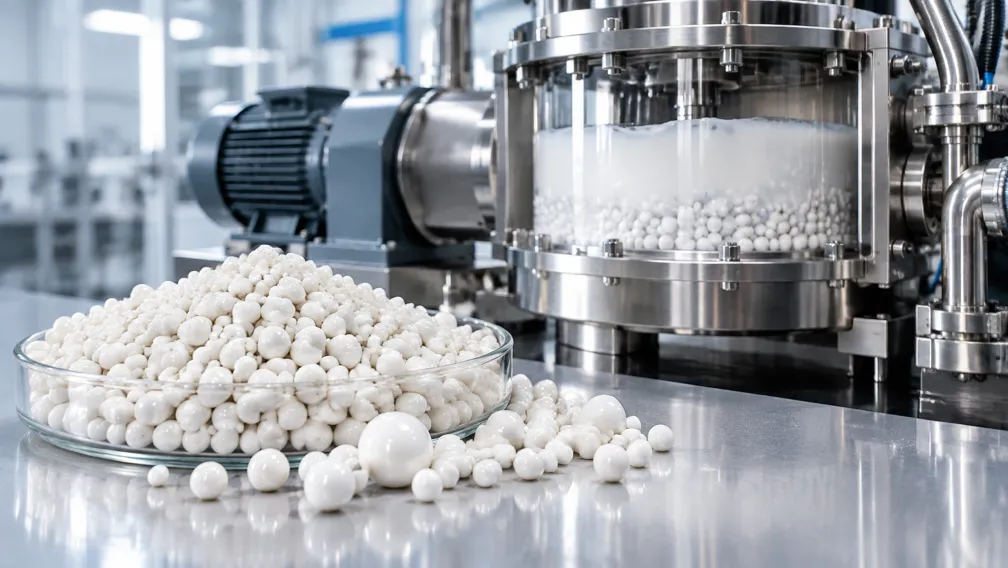
Stirred media mills (such as horizontal pin mills and vertical attritors) operate via the high-velocity agitation of a dense bed of ceramic grinding media and process slurry. As the rotating pins transfer kinetic energy to the ceramic beads, particle size reduction occurs through a combination of high-frequency compressive impact and localized shear forces.
Unlike traditional tumbling ball mills, stirred mills generate high shear rates within narrow interstitial gaps between adjacent beads. The efficiency of this energy transfer depends on the volumetric filling ratio, the tip speed of the agitator, and the specific gravity of the media. When transitioning to sub-micron or nano-scale milling, operating engineers must utilize high-density yttria-stabilized zirconia or ceria-stabilized zirconia beads. Low-density media completely lacks the mass required to overcome viscous drag in concentrated, fine-particle slurries, leading to stagnant zones and inefficient grinding.
The 10-100 Geometric Rule for Bead Sizing
Selecting the correct bead diameter is the single most important parameter in optimizing mill performance. If the selected beads are excessively large, the total number of contact points within the chamber drops drastically, resulting in slow grinding kinetics and a wide particle size distribution. Conversely, if the beads are too small, they lack the mass and momentum required to fracture large incoming feed agglomerates, causing the feed inlet to choke.
Chemical engineers govern bead sizing using the established 10-100 geometric rule:
- Feed-to-Bead Ratio: The selected bead diameter must be 10 to 30 times larger than the largest particle size ($D_{90}$) present in the incoming feed slurry. This ensures adequate impact mass to crush coarse agglomerates.
- Target-to-Bead Ratio: The bead diameter should be approximately 1,000 times larger than the final target average particle size ($D_{50}$). To achieve a 500-nanometer target, operators must deploy 0.5 mm micro-beads.
When dropping to sub-millimeter bead sizes, the dynamic separation screen at the mill discharge must feature slot openings significantly smaller than the smallest bead (typically half the bead diameter) to prevent media loss.
Slurry Rheology, Solids Loading, and Viscosity
The fluid medium surrounding the grinding media—the slurry—determines how effectively kinetic energy is transmitted throughout the chamber. Slurry rheology is defined by its solids loading, pH, and apparent viscosity.
As wet milling progresses and particle size shrinks from tens of microns down to nanometers, the total specific surface area of the solids multiplies exponentially. This massive surge in surface area binds a significant fraction of the free liquid in the system, causing the apparent viscosity of the slurry to spike dramatically. If the viscosity becomes too high, the slurry acts as a thick cushion between the beads, absorbing impact energy and stalling the mill.
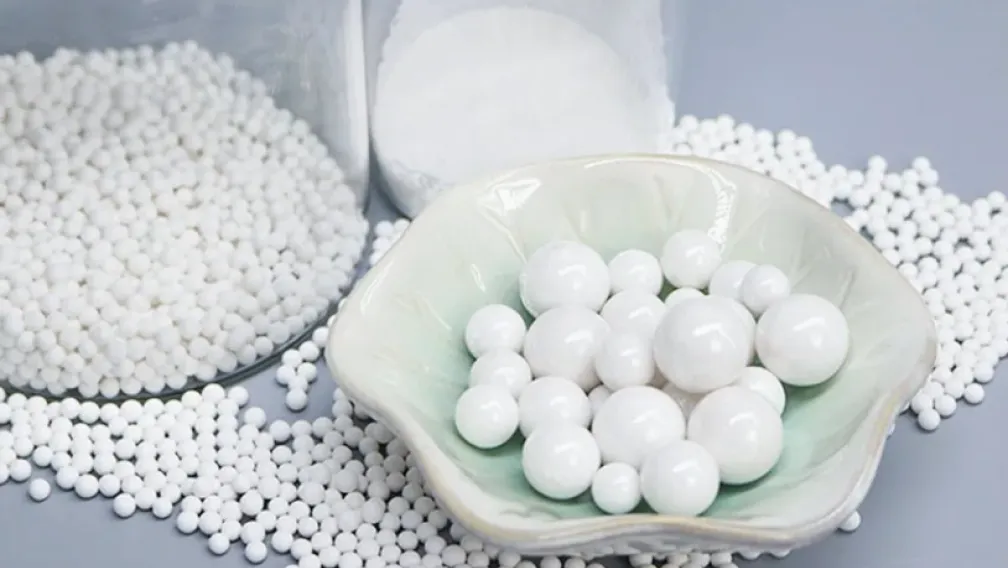
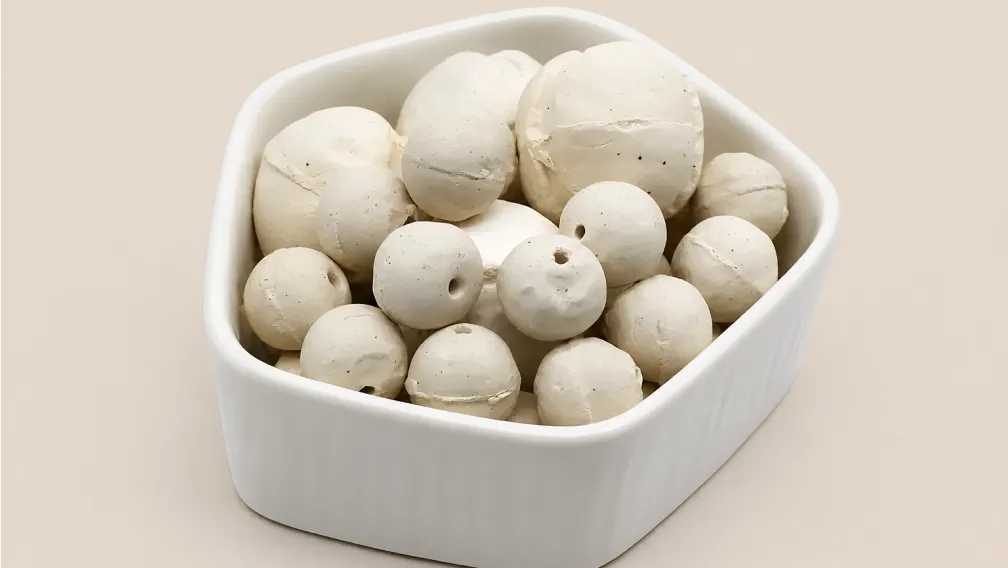
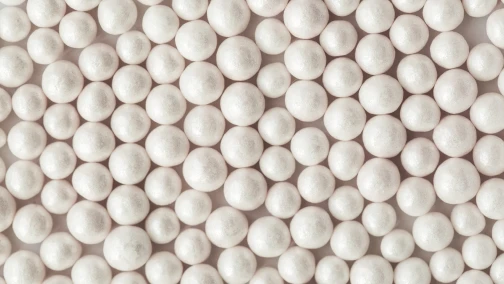
To prevent viscosity spikes, operators must optimize dispersant and surfactant dosages to maintain Newtonian or shear-thinning fluid behavior. Furthermore, high-performance alumina grinding balls and zirconia grinding balls must maintain high sphericity and smooth surface finishes; rough or porous beads increase internal fluid friction, raising operating temperatures and destabilizing slurry rheology.
Wear Mechanisms and Contamination Control
All ceramic grinding media experience mechanical wear over time through continuous abrasion and high-speed impact. Minimizing this wear is critical, as abraded ceramic fragments contaminate the product slurry and accelerate the destruction of expensive mill internals.
Wear rates are typically quantified by weight loss over operational hours (ppm or g/kWh). Low-quality beads containing internal micro-porosity or trapped air voids fail rapidly under continuous shear stress, fracturing into sharp, jagged shards. These ceramic shards act as cutting tools, rapidly abrading the polyurethane or hardened steel agitator pins and plugging the dynamic discharge screens.
To achieve ultra-low wear rates in high-purity applications—such as lithium-ion battery cathode slurries—plants strictly specify isostatically pressed, pore-free yttria-stabilized zirconia media. The extreme fracture toughness of this material ensures that beads wear down smoothly via micro-abrasion rather than catastrophic shattering, protecting product purity and extending maintenance intervals.
Where Rongjian Fits
Pingxiang Rongjian manufactures precision ceramic grinding media engineered for high-performance wet milling and mechanical dispersion. We produce a comprehensive portfolio of high-purity alumina beads for standard mineral processing alongside advanced yttria-stabilized zirconia micro-beads designed for ultra-fine nano-milling in battery, coating, and electronic ceramic applications. Our strict sintering controls guarantee high sphericity, uniform density, and zero internal porosity, ensuring ultra-low wear rates and preventing screen blinding in continuous stirred mills. Contact our technical team with your feed particle size and target $D_{50}$ for a customized media sizing and mill optimization proposal.
-

Rongjian
Process Media Manufacturer Since 2010
Rongjian produces tower packing, molecular sieves, ceramic grinding media and other process media from our Pingxiang production base. We supply to industrial projects in over 100 countries.