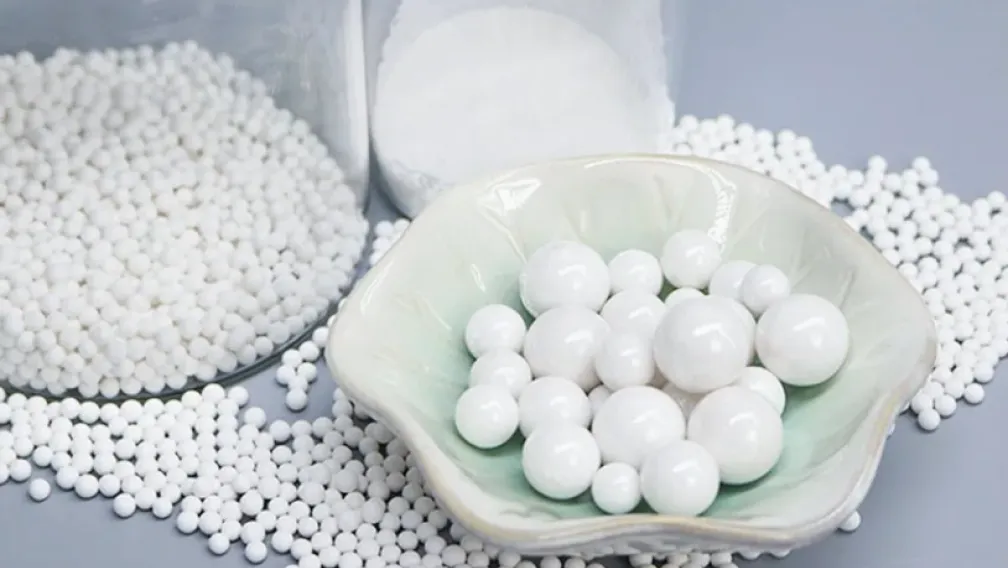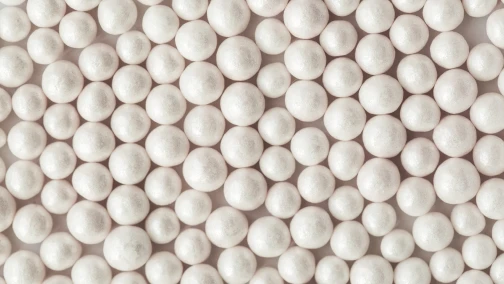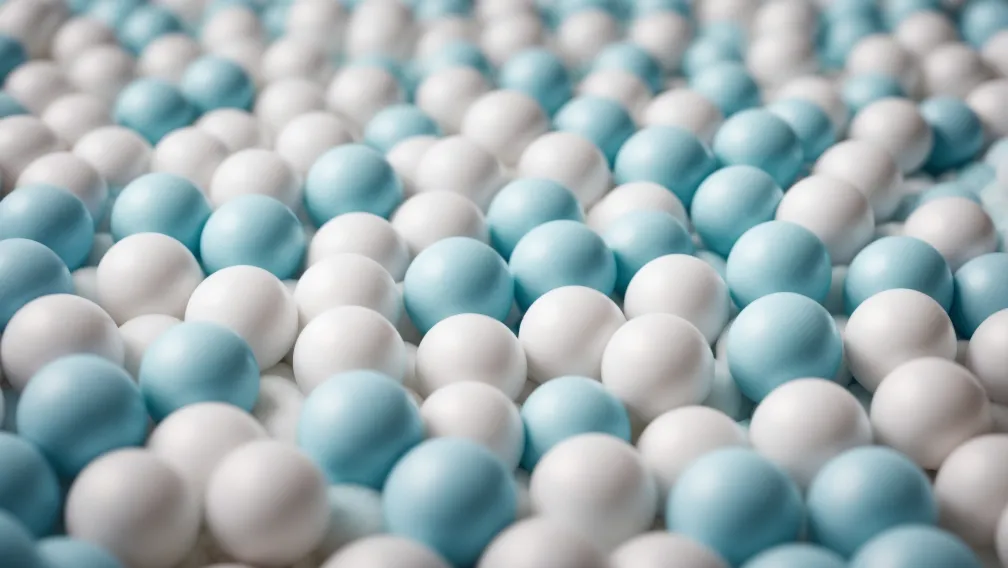

Ultra-fine wet milling in horizontal or vertical bead mills relies entirely on the kinetic energy transferred from the agitator shaft to the grinding media. The media—thousands of highly spherical ceramic beads—performs the actual mechanical work of particle size reduction. As industries push toward sub-micron and nanometer particle targets in lithium-ion battery materials, high-performance coatings, and inkjet inks, the physical properties of the grinding media dictate the efficiency of the entire plant. Selecting between alumina and zirconia grinding media requires an exact analysis of specific gravity, fracture toughness, wear rate, and product contamination limits. This guide covers the physics of bead milling, material grade differences, and the engineering rules for selecting optimal bead diameters.
The Physics of Bead Milling: Kinetic Energy and Shear
Particle size reduction in a bead mill occurs through two primary mechanisms: direct impact and localized shear. When the agitator discs or pins rotate at high speeds (typically 8 to 14 m/s tip speed), they accelerate the ceramic beads. The beads collide with each other and with the mill wall.
The impact energy generated by a single bead collision is governed by the kinetic energy formula: $E = \frac{1}{2}mv^2$. Because mass ($m$) is a direct function of the bead's volume and specific gravity (density), a denser bead delivers exponentially more impact energy at the same agitator speed. Furthermore, as the target particle size drops into the nanometer range, engineers must use extremely small beads (down to 0.1 mm) to increase the number of contact points. A 0.1 mm bead has very little volume. If it is manufactured from a low-density material, it completely lacks the mass required to overcome the fluid viscosity of the slurry and fracture the target particle. This physical law strictly mandates the use of high-density media for ultra-fine nano-milling.
Alumina Grinding Media: Specifications and Applications
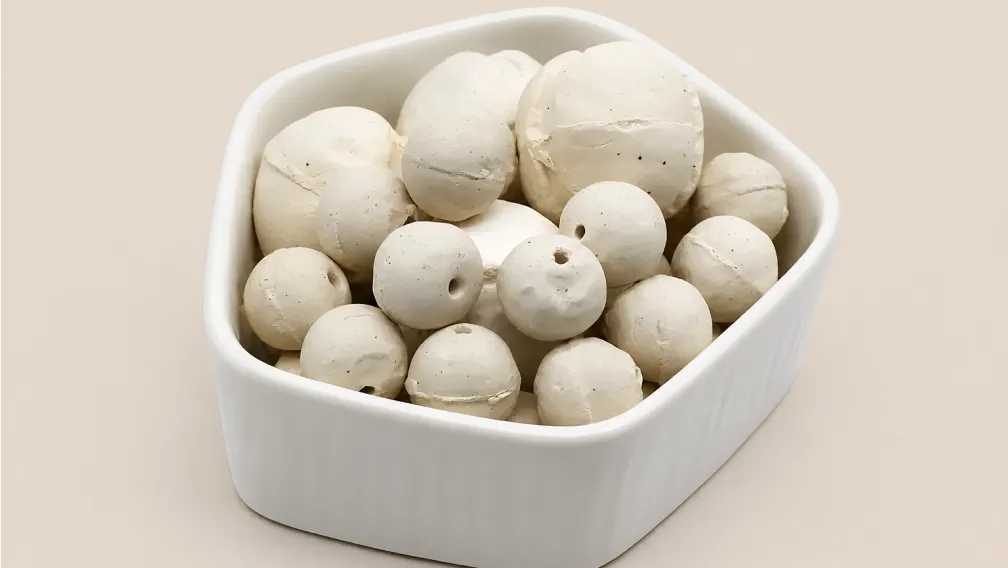
Alumina grinding balls provide a highly cost-effective solution for coarse to medium-fine milling tasks. They are manufactured primarily from aluminum oxide ($Al_2O_3$). Industrial applications generally utilize two grades: 92% alumina and 99% alumina.
A standard 92% alumina bead possesses a specific gravity of approximately 3.6 g/cm³. It exhibits high hardness (Mohs 9) and excellent chemical resistance. Alumina media operates efficiently in large-volume ball mills and attritors processing standard minerals, calcium carbonate, cement, and basic architectural paints.
The primary limitation of alumina is its relatively high wear rate and lower fracture toughness compared to zirconia. In high-speed bead mills, the brittle nature of alumina leads to micro-chipping. The abraded aluminum oxide contaminates the product slurry. While this silica and alumina contamination is perfectly acceptable in white paints or generic ceramics, it is strictly prohibited in electronic materials and high-purity pigments.
Zirconia Grinding Media: The Standard for High-Performance Milling
Zirconia ($ZrO_2$) exhibits exceptional mechanical properties, characterized by extreme density and high fracture toughness. Pure zirconia undergoes a disruptive phase transformation during cooling, causing it to crack. To stabilize the crystalline structure at room temperature, manufacturers dope the zirconia with rare earth oxides. This creates three distinct industrial categories of zirconia grinding balls.
Zirconium Silicate (ZrSiO4)
Zirconium silicate is an economical, mid-tier media with a specific gravity of roughly 4.0 g/cm³. It bridges the gap between alumina and pure zirconia. It provides good wear resistance for dispersing medium-viscosity inks, agrochemicals, and automotive coatings where moderate contamination is acceptable, but it lacks the density for true nano-milling.
Ceria-Stabilized Zirconia (CSZ)
Ceria-stabilized zirconia utilizes Cerium Oxide ($CeO_2$) as the stabilizing agent. It boasts an exceptionally high specific gravity of 6.2 g/cm³. This massive density makes CSZ the preferred media for milling highly viscous slurries, heavy metal ores, and offset inks. The heavy beads easily penetrate viscous fluids, maintaining high kinetic impact forces where lighter beads would simply float or stall within the matrix.
Yttria-Stabilized Zirconia (YSZ)
Yttria-stabilized zirconia represents the pinnacle of ceramic grinding media. Stabilized with Yttrium Oxide ($Y_2O_3$), it features a specific gravity of 6.0 g/cm³ and possesses the highest fracture toughness of any ceramic bead. This extreme toughness virtually eliminates bead shattering inside the mill.
YSZ is the absolute mandatory standard for lithium-ion battery materials, specifically cathode (LFP, NMC) and anode slurry preparation. Battery electrochemistry has zero tolerance for iron or heavy metal contamination. YSZ media provides an infinitesimally low wear rate (often measured in low parts-per-million per hour). Furthermore, because YSZ can be manufactured down to 0.05 mm diameters without losing structural integrity, it is the exclusive media used for sub-micron and nano-scale grinding in pharmaceuticals, cosmetics, and semiconductor polishing slurries.
Bead Size Selection Rules
Selecting the correct bead diameter is just as critical as selecting the material. If the beads are too large, the mill generates too few contact points, resulting in poor dispersion and a wide particle size distribution. If the beads are too small, they lack the mass to fracture the large incoming feed particles, causing the mill to choke.
Chemical engineers follow the 10-100 geometric rule for media sizing:
1. The bead diameter should be 10 to 30 times larger than the largest particle in the raw feed ($D_{90}$). This ensures the bead has sufficient mass to crush the coarse agglomerates.
2. The bead diameter should be approximately 1,000 times larger than the target average particle size ($D_{50}$).
For example, to achieve a target particle size of 0.5 microns (500 nanometers), the operator should select a bead size of 0.5 mm. To achieve a 100-nanometer target, the operator must drop to a 0.1 mm bead. When dropping to these extreme micro-bead sizes, the operator must simultaneously upgrade to a high-density YSZ media to maintain sufficient kinetic energy.
Mill Filling Ratio and Heat Generation
The volumetric filling ratio of the grinding chamber directly dictates power draw and throughput. Horizontal bead mills typically operate with a media filling ratio between 70% and 85% of the total chamber volume. Vertical mills operate between 50% and 70%.
Overfilling the mill (above 85%) severely restricts fluid flow, spikes the internal pressure, and drastically increases the frictional heat generated by bead-to-bead contact. Because mechanical milling is inherently inefficient—converting massive amounts of kinetic energy into thermal energy—excessive heat degrades temperature-sensitive pigments and boils the solvent. Proper filling ratios ensure the slurry acts as a lubricant and coolant between the beads.
Calculating and Monitoring Wear Rates
All ceramic media wears over time. The wear rate determines the operational expenditure of the mill and the purity of the final product. Wear occurs through continuous abrasion against the slurry and impact fracture against the mill walls.
Wear is calculated either by weight loss over a set period of operation (g/hour) or by analyzing the parts-per-million (ppm) of zirconium or aluminum present in the finished product. Low-quality beads contain internal pores and air pockets. Under high-speed impact, these defective beads fracture rather than abrade. Fractured media leaves sharp, jagged ceramic shards in the mill. These shards act like cutting tools, rapidly destroying the expensive polyurethane or hardened steel agitator pins and plugging the dynamic separation screen at the discharge port. Sourcing highly spherical, dense, pore-free media is the only reliable method to prevent catastrophic screen plugging.
Where Rongjian Fits
Pingxiang Rongjian manufactures precision ceramic grinding media for high-performance wet milling and dispersion. We produce a complete portfolio including 92% and 99% alumina grinding balls for large-scale mineral processing, and yttria-stabilized zirconia (YSZ) micro-beads for nano-scale battery materials and high-purity inks. Our advanced extrusion and rolling processes guarantee high sphericity and zero internal porosity, ensuring ultra-low wear rates and preventing mill screen blinding. Whether you are running a horizontal peg mill for lithium cathode slurries or a basket mill for industrial coatings, we supply the exact bead density and diameter required to hit your target particle size distribution. Contact our technical team with your initial feed size and target $D_{50}$ for a media sizing recommendation.
-

Rongjian
Process Media Manufacturer Since 2010
Rongjian produces tower packing, molecular sieves, ceramic grinding media and other process media from our Pingxiang production base. We supply to industrial projects in over 100 countries.