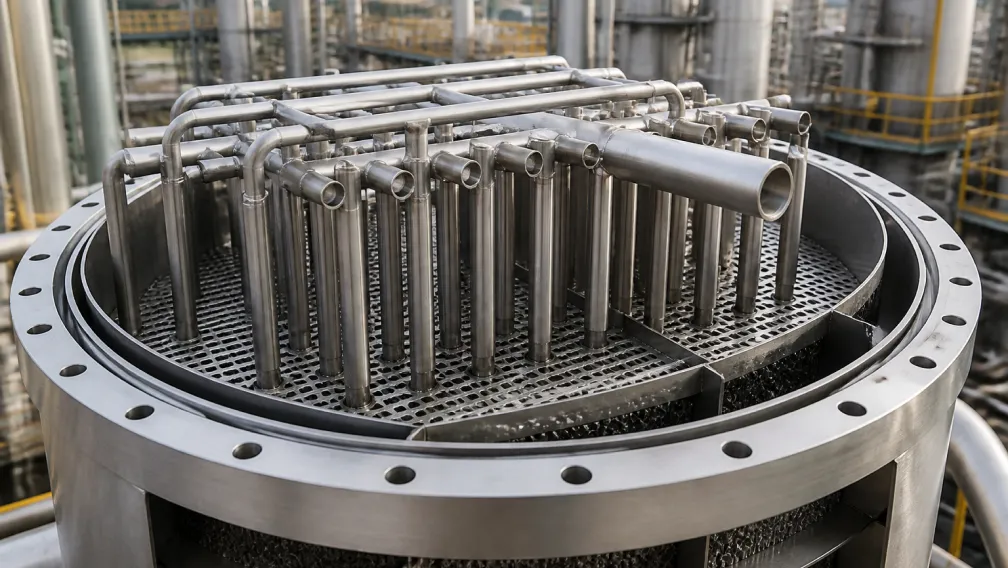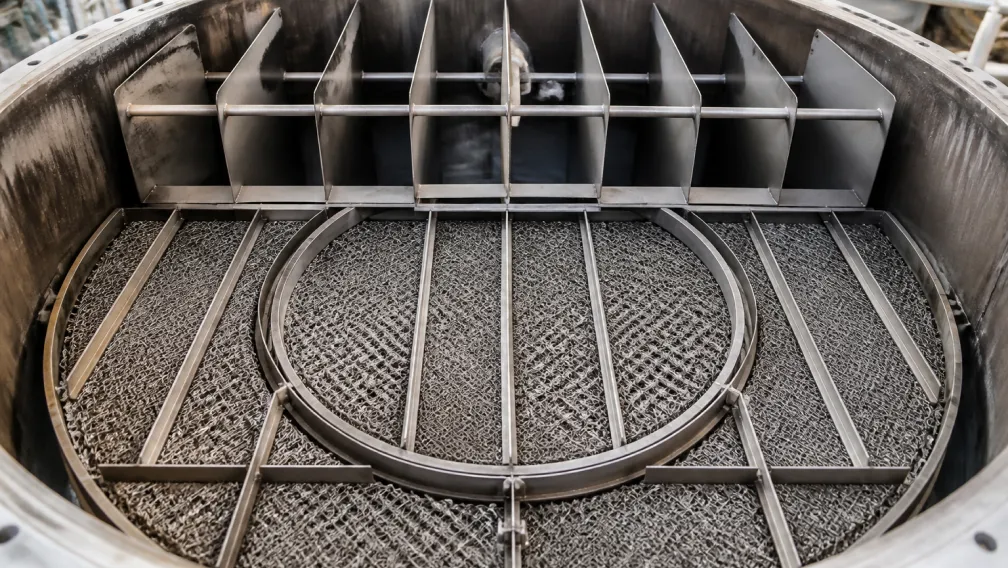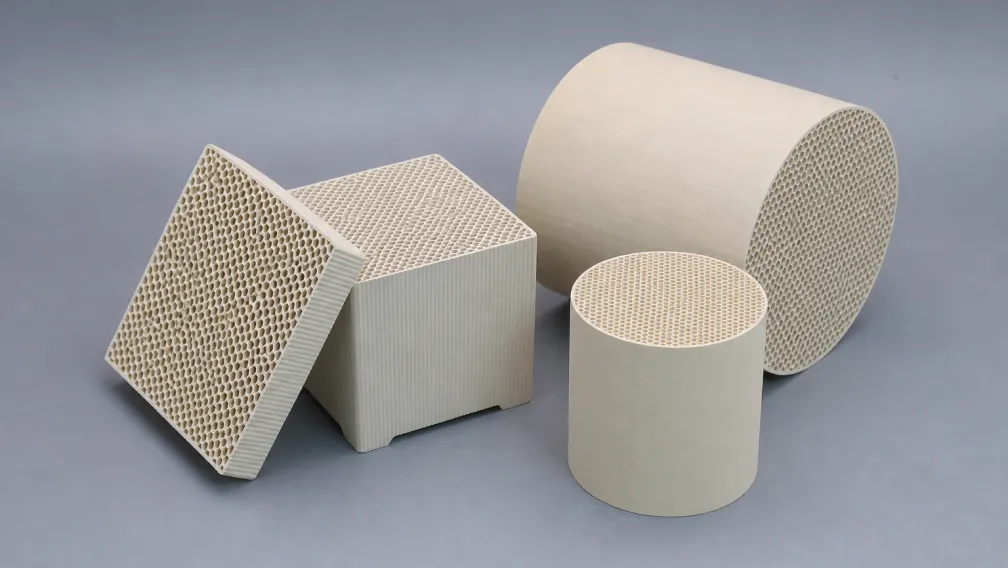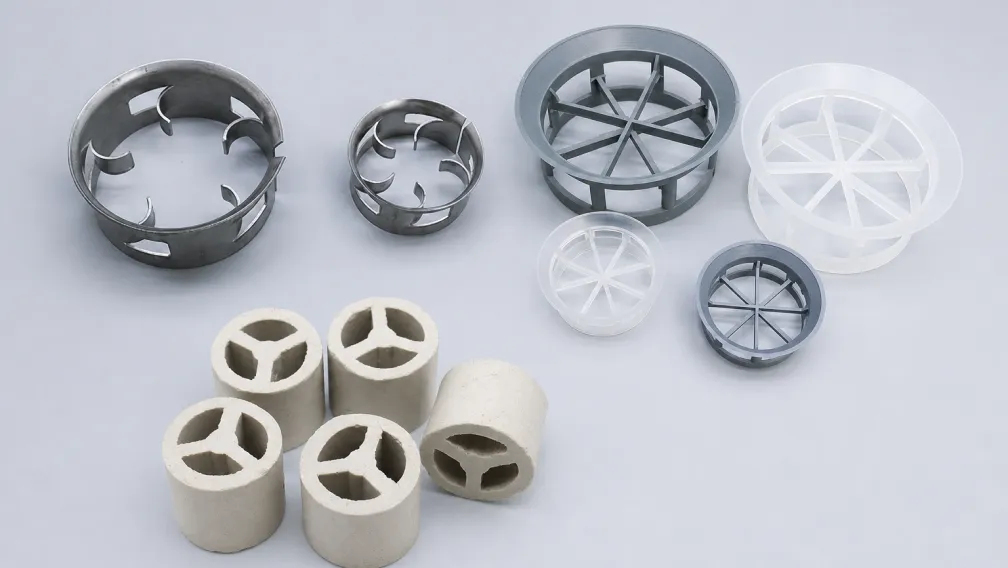

Mist eliminators are critical internals within chemical separation towers, scrubbers, and knock-out drums. As vapor travels upward through a gas-liquid contactor, it inevitably shears microscopic liquid droplets from the liquid phase and carries them upward. This phenomenon is known as liquid entrainment. If left unchecked, liquid carryover damages downstream compressors, causes severe corrosion in piping, poisons expensive catalyst beds, and results in direct product loss. Mist eliminators intercept this entrained liquid, coalesce the microscopic droplets into larger drops, and return the liquid to the process. Selecting the correct type of mist eliminator—primarily choosing between a wire mesh pad or a vane chevron type—determines the vessel's maximum operating capacity, the pressure drop, and the maintenance interval of the column.
The Physics of Droplet Capture
Mist eliminators rely on three primary physical mechanisms to remove liquid from a gas stream. The dominance of each mechanism depends entirely on the size of the target droplet and the velocity of the gas.
Inertial Impaction: This is the primary mechanism for capturing droplets larger than 5 microns. As the vapor stream approaches an obstacle (a wire or a steel plate), the gas streamlines bend to flow around it. The liquid droplets possess greater mass and momentum than the gas. They fail to follow the bending streamlines, continue on a straight trajectory, and smash into the obstacle. The droplet adheres to the surface, merges with other droplets, and eventually drains by gravity.
Direct Interception: This mechanism captures intermediate droplets, typically between 1 and 5 microns. The droplet follows the gas streamline around the obstacle, but the streamline passes so close to the solid surface that the edge of the droplet physically grazes the material and is captured.
Brownian Diffusion: This applies only to submicron mists (less than 1 micron). These tiny droplets are constantly buffeted by surrounding gas molecules, causing them to move in a random, erratic path. This random motion eventually causes them to collide with a highly dense matrix of microscopic fibers. Standard mesh and vane eliminators do not rely on Brownian diffusion; capturing submicron mist requires specialized fiber bed coalescers.
Wire Mesh Demister Pads
A wire mesh demister consists of multiple layers of knitted wire. Manufacturers crimp the knitted mesh and stack it to achieve a specific thickness and density. The structure creates a dense maze of asymmetrical flow paths.
The defining characteristic of a metal wire mesh demister pad is its exceptionally high void fraction, typically ranging from 97% to 99%. This means the pad is mostly empty space, allowing gas to pass through with very low resistance. The pressure drop across a clean, properly sized wire mesh pad is usually less than 25 mm of water column (1 inch WC).
Wire mesh pads provide extremely high separation efficiency. A standard density pad removes 99% of liquid droplets down to 3 to 5 microns in diameter. To capture even finer droplets (down to 2 microns), manufacturers co-knit the metallic wire with multifilament synthetic fibers, such as PTFE or fiberglass. The multifilament fibers drastically increase the specific surface area and enhance the interception of microscopic mist.
The primary limitation of a wire mesh pad is its vulnerability to fouling. The intricate, tightly packed wire structure acts as an excellent filter for solid particulates, polymers, and sticky hydrocarbons. In dirty services, the mesh rapidly plugs, forcing the gas velocity to spike through the remaining open areas. This leads to severe pressure drop and complete liquid re-entrainment. Therefore, wire mesh demisters are strictly reserved for clean gas services.
Vane (Chevron) Mist Eliminators
Vane mist eliminators, also known as chevron baffles, consist of a series of parallel, corrugated metal or plastic plates. The vapor stream enters the vane assembly and is forced to change direction several times as it navigates the zig-zag channels.
The heavier liquid droplets cannot navigate the sharp turns due to their inertia. They impact the corrugated walls and form a liquid film. To prevent the high-velocity gas from tearing this film off the wall, advanced vane mist eliminators incorporate drainage hooks or pockets. These hooks shield the collected liquid from the gas flow, allowing it to drain safely to the bottom of the assembly.
Vane eliminators capture larger droplets compared to wire mesh. A standard vane removes 99% of droplets larger than 10 to 20 microns. While their efficiency on fine mist is lower, vanes offer massive operational advantages in severe services.
First, vanes handle significantly higher gas velocities and liquid loads than wire mesh. They act as robust bulk separators. Second, the wide, open channels between the corrugated plates resist fouling. Vanes easily process dirty streams containing solid particulates, viscous oils, and foaming liquids. If fouling does occur, the straight vertical channels allow for easy cleaning via high-pressure wash nozzles installed directly above the assembly.
Sizing Mist Eliminators: The Souders-Brown Equation
Proper sizing of any tower internal is dictated by the maximum allowable vapor velocity. If the gas velocity is too high, the drag force exceeds the gravitational force acting on the liquid. The gas will literally tear the coalesced droplets off the mesh or vane surface and carry them out the top of the vessel. This is known as re-entrainment.
Conversely, if the gas velocity is too low, the droplets lack the momentum required for inertial impaction. The mist simply follows the gas streamlines around the wires or plates and escapes. This is known as bypassing.
Engineers calculate the maximum design velocity using the industry-standard Souders-Brown equation:
V = K × √ [ (ρL - ρG) / ρG ]
Where:
V = Maximum allowable vapor velocity (m/s)
K = Capacity factor, empirically determined by the eliminator design (m/s)
ρL = Density of the liquid phase (kg/m³)
ρG = Density of the gas phase (kg/m³)
The K-factor is the critical design variable. For a standard horizontal wire mesh pad under atmospheric conditions, the baseline K-factor is typically 0.107 m/s (0.35 ft/s). For vane eliminators, the K-factor is much higher, ranging from 0.15 to 0.20 m/s depending on the spacing and hook design. This mathematically proves that a vessel equipped with a vane eliminator can process a much larger volume of gas than a vessel of the exact same diameter equipped with a wire mesh pad.
The baseline K-factor must be derated based on operating conditions. High operating pressure drastically increases gas density, which lowers the surface tension of the liquid droplets. In high-pressure applications (above 10 bar), the K-factor must be reduced by 10% to 30% to prevent re-entrainment. Similarly, high-viscosity liquids drain slower, requiring a lower K-factor to prevent liquid accumulation and flooding within the pad.
Installation Configurations and Drainage
Mist eliminators are installed in two primary configurations: horizontal and vertical.
In a horizontal installation, the gas flows vertically upward through the face of the pad, and the captured liquid drains vertically downward, directly against the flow of the gas. This counter-current flow places a strict limit on the liquid handling capacity. If the liquid load becomes too high, the upward gas velocity prevents the liquid from draining. The liquid pools inside the mesh, eventually causing a sudden and massive liquid carryover.
In a vertical installation, the gas flows horizontally through the face of the pad. The captured liquid still drains vertically downward, perpendicular to the gas flow. This cross-flow design removes the aerodynamic drag on the draining liquid. Vertical installations can handle significantly higher liquid loads and are almost universally used for vane mist eliminators in heavy liquid knock-out drums.
Material Selection for Severe Environments
The thin wires of a mesh pad (typically 0.28 mm in diameter) are highly susceptible to corrosion. A slight corrosion rate that is acceptable for the thick steel wall of the vessel will rapidly dissolve a wire mesh pad. Therefore, mesh pads are usually specified in a higher alloy than the vessel body.
Standard applications utilize 304L or 316L stainless steel. For environments containing chlorides or acids, engineers specify Monel 400, Titanium, or Alloy 20. In severe corrosive services where metallurgy becomes cost-prohibitive, plastic media provides an excellent alternative. Polypropylene (PP) and PTFE wire mesh pads offer total chemical resistance against aggressive acids, provided the operating temperature remains below the structural limits of the polymer.
Troubleshooting Liquid Carryover
When a column experiences sudden liquid carryover, operators must diagnose whether the mist eliminator has failed mechanically or if the process conditions have drifted outside the design envelope.
A sudden spike in pressure drop usually indicates fouling. The open area of the eliminator has decreased, forcing the gas velocity to spike through the remaining gaps, leading to severe re-entrainment. The solution requires shutting down the vessel and physically washing or replacing the pad.
If carryover occurs with no significant increase in pressure drop, the unit is likely operating below its minimum design velocity. Plant throughput may have been reduced, causing the gas velocity to drop so low that inertial impaction ceases. Droplets are bypassing the wires entirely. The engineering solution requires blanking off a portion of the eliminator face to artificially reduce the open area, forcing the gas velocity back up into the optimal operational range.
Where Rongjian Fits
Rongjian manufactures custom-engineered tower internals for the petrochemical and oil and gas industries. We produce wire mesh demister pads in all standard densities and exotic metallurgies, including co-knit designs for ultra-fine mist capture. For heavy-duty applications prone to fouling, we manufacture robust chevron vane mist eliminators with specialized liquid drainage hooks to handle extreme gas velocities. Our engineering team calculates the exact K-factor required for your specific stream density and viscosity, ensuring you receive an internal that eliminates carryover without throttling your production capacity. Provide us with your operating pressures, gas-liquid flow rates, and vessel dimensions for a detailed sizing proposal.
-

Rongjian
Process Media Manufacturer Since 2010
Rongjian produces tower packing, molecular sieves, ceramic grinding media and other process media from our Pingxiang production base. We supply to industrial projects in over 100 countries.