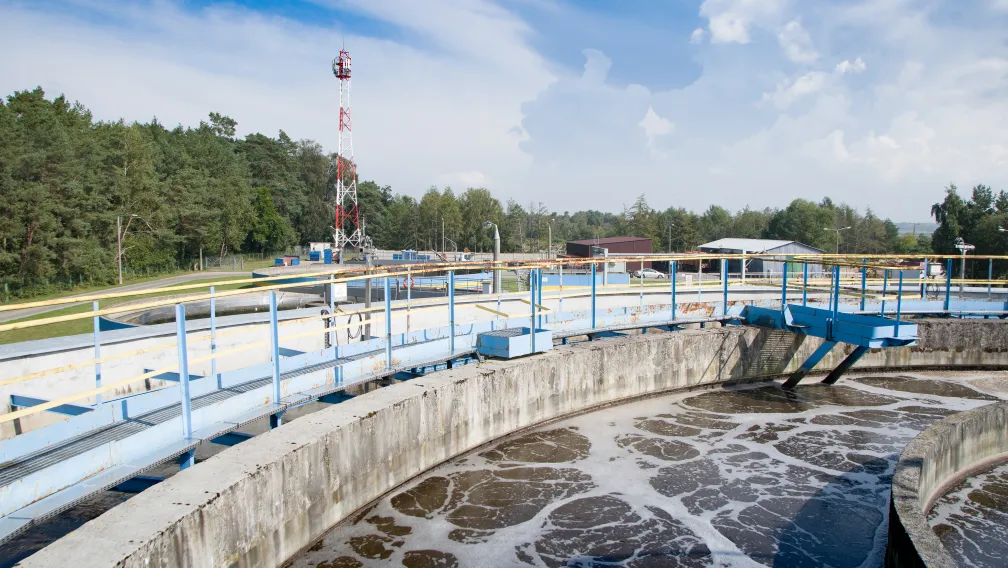

The Moving Bed Biofilm Reactor (MBBR) represents a highly efficient biological treatment process for municipal and industrial wastewater. Unlike conventional activated sludge systems where bacteria are suspended in mixed liquor, an MBBR utilizes thousands of small plastic carriers suspended in the reactor. These carriers provide a vast, protected surface area for autotrophic and heterotrophic bacteria to colonize and form a stable biofilm. This attached-growth process allows treatment plants to handle massive organic and ammonia loads within a very small footprint. Designing an efficient MBBR system relies strictly on the geometry of the carrier, the active surface area, the fill fraction of the reactor, and the fluid dynamics generated by the aeration system. This guide breaks down the engineering principles governing MBBR media selection and performance.
The Fundamental Mechanics of MBBR Technology
In a standard activated sludge process, the concentration of biomass is limited by the capacity of the secondary clarifier to settle out the sludge. If the mixed liquor suspended solids (MLSS) concentration rises too high, the clarifier fails, and solids wash out in the effluent.
MBBR technology bypasses this limitation. The biomass remains physically attached to the plastic carriers inside the aeration tank. Screens or sieves installed at the effluent pipe keep the carriers within the reactor. Because the bacteria are fixed to the media, the reactor maintains an extremely high concentration of active biomass without overloading downstream clarifiers. This fixed-film design eliminates the need for sludge recirculation (RAS), vastly simplifying plant operation and eliminating sludge bulking issues.
Protected Surface Area vs. Total Surface Area
When engineers evaluate MBBR media, the primary metric is specific surface area, expressed in square meters per cubic meter of media ($m^2/m^3$). However, evaluating media based on "total surface area" is a fundamental engineering error.
MBBR carriers continuously collide with one another and with the reactor walls due to the turbulent mixing of the water. Any biofilm growing on the exterior of the carrier is immediately sheared off by these mechanical collisions. Biofilm only survives within the sheltered internal geometries of the plastic shape. Therefore, the only metric that dictates reactor performance is the Protected Surface Area (also called Active Surface Area).
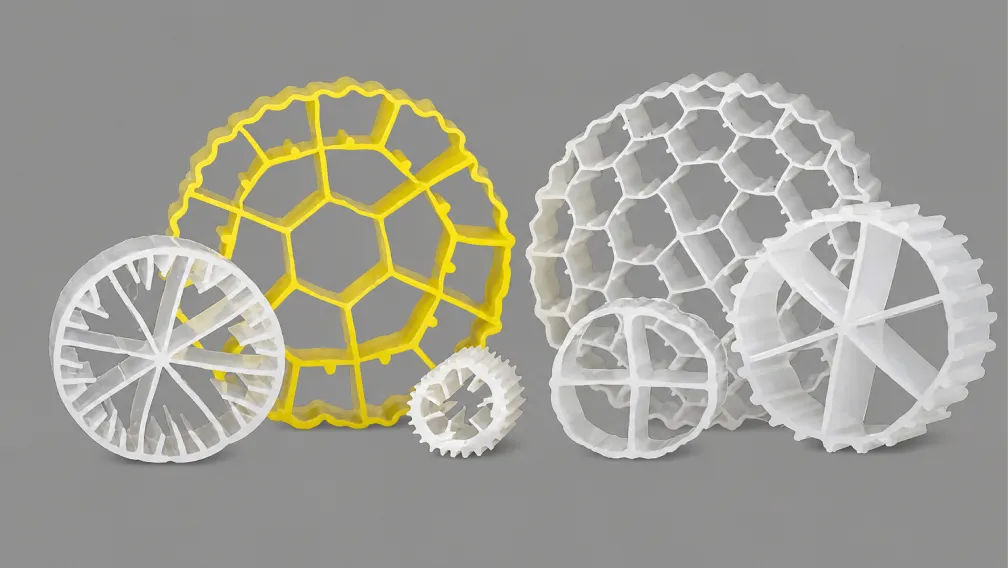
A standard K1 moving bed biofilm media provides a protected surface area of approximately $500 \, m^2/m^3$. Advanced carrier designs with tighter internal cross-hatching or specialized shapes like the Igel ball can provide active areas exceeding $800 \, m^2/m^3$ or even $1,200 \, m^2/m^3$. Plant designers use this protected surface area to calculate the Surface Area Loading Rate (SALR), which dictates exactly how much media volume is required to degrade a specific daily load of BOD or ammonia.
Biofilm Diffusion and Kinetic Rate Limitations
Biological treatment in an MBBR is limited by diffusion. Substrates (such as dissolved oxygen, ammonia, and organic carbon) must physically diffuse from the bulk liquid into the dense biofilm matrix. The bacteria deep inside the biofilm rely on the bacteria at the surface to pass these nutrients downward.
Oxygen penetration is typically the limiting factor. Dissolved oxygen generally penetrates only $100$ to $200$ microns deep into a biofilm. If the biofilm grows thicker than this limit, the deeper layers become anaerobic and die, causing the entire biofilm to slough off the carrier in large chunks. To maintain a highly active, thin biofilm, the reactor requires continuous, aggressive mixing. The hydrodynamic shear forces generated by aeration continuously trim the biofilm, preventing it from clogging the internal channels of the carrier and ensuring the bacteria remain in a high-rate growth phase.
Carrier Density, Buoyancy, and Reactor Mixing
The physical density of the plastic carrier dictates how it behaves in the water column. MBBR media is almost exclusively manufactured from virgin High-Density Polyethylene (HDPE). HDPE provides a specific gravity between $0.95$ and $0.98 \, g/cm^3$.
Because the media is slightly lighter than water, it naturally floats. Once the carriers are colonized by dense biological sludge, their overall specific gravity approaches $1.00$, making them neutrally buoyant. This neutral buoyancy is critical. It allows the carriers to disperse evenly throughout the entire reactor volume using minimal mixing energy. If the plastic is manufactured incorrectly and the density is too high, the media sinks and accumulates on the reactor floor, creating anaerobic dead zones.
To maintain suspension, aerobic MBBR tanks utilize coarse bubble diffusers or perforated stainless steel pipes. Fine bubble diffusers, common in activated sludge, do not generate enough turbulent mixing energy to keep the carriers moving. In anoxic or anaerobic MBBR tanks (used for denitrification), mechanical submersible mixers provide the thrust required to keep the media in suspension.
Fill Fraction Specifications and Limitations
The fill fraction is the percentage of the reactor's total wet volume displaced by the bulk volume of the carriers. Designing the correct fill fraction balances treatment capacity against mechanical limits.
Engineers typically design new MBBR reactors with a fill fraction between $30\%$ and $50\%$. This leaves ample room for the carriers to move freely, collide, and shed excess biofilm. The absolute maximum operable fill fraction is generally capped at $65\%$ to $70\%$. Exceeding $70\%$ fill fraction chokes the fluid dynamics. The media locks together at the surface, aeration air channels straight through the bed without mixing it, and the reactor functions as a static trickling filter rather than a moving bed. By designing a new plant at a $35\%$ fill fraction, operators reserve the physical space to easily upgrade the plant's capacity in the future simply by dumping more media into the existing tank.
Integrated Fixed-Film Activated Sludge (IFAS) Upgrades
MBBR media is frequently used to upgrade existing, overloaded municipal wastewater plants through a process called IFAS (Integrated Fixed-Film Activated Sludge). An IFAS system combines suspended biomass and fixed-film carriers in the same aeration basin.
When a municipal plant faces stricter ammonia discharge limits, the existing aeration basins often lack the retention time required for slow-growing nitrifying bacteria to proliferate. Expanding the concrete basins is capital-intensive. Instead, engineers drop MBBR media directly into the existing activated sludge tanks and install retention screens. The nitrifying bacteria colonize the protected surface of the carriers and remain permanently in the tank, while the suspended sludge continues to handle the bulk organic carbon (BOD). This hybrid approach instantly upgrades the nitrification capacity of the plant without requiring any additional tank footprint or overloading the secondary clarifiers.
Sieve Design and Carrier Retention
Because the carriers move freely with the water flow, the reactor effluent pipe must be fitted with a retention sieve to prevent the media from washing downstream. The design of this sieve is a common point of mechanical failure.
Standard K1 media has a diameter of roughly $10 \, mm$. The sieve slots are typically cut at $5 \, mm$ to $7 \, mm$ to ensure positive retention. If the approach velocity of the water hitting the sieve is too high, the hydraulic force pins the plastic carriers against the screen, blinding the slots and causing the reactor to overflow. Engineers design the sieves (either flat panels or cylindrical wedges) with a massive surface area to keep the approach velocity below $0.05 \, m/s$. Aeration pipes are also installed directly beneath the sieves to scour the screen with air bubbles, continuously knocking carriers away from the slots.
Material Science: HDPE Extrusion and Durability
An MBBR carrier operates in a violently abrasive environment, constantly colliding with concrete walls, steel pipes, and billions of other carriers for 15 to 20 years. Material integrity is non-negotiable.
High-quality carriers are extruded solely from virgin HDPE. The addition of recycled plastics or low-density fillers creates brittle carriers that shatter under mechanical stress. When a carrier breaks, the fragments pass through the effluent sieves, contaminating downstream equipment and the local environment. Furthermore, virgin HDPE offers superior resistance to UV degradation (for open-top tanks) and chemical breakdown from aggressive industrial effluents. Manufacturers strictly control the extrusion cooling rate to ensure the internal walls form with precision, providing the exact specific surface area specified in the engineering calculations.
Where Rongjian Fits
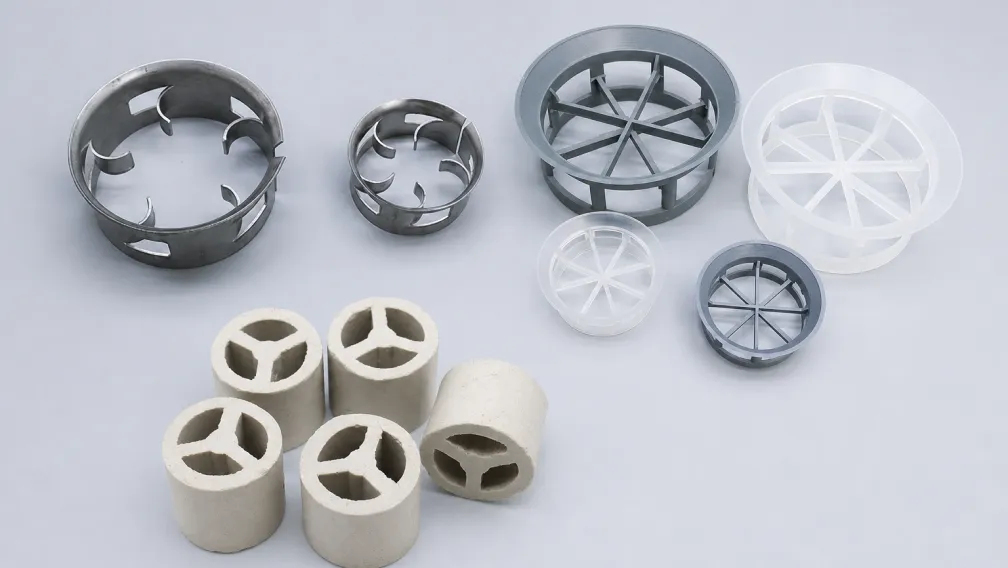
Pingxiang Rongjian manufactures high-durability plastic mass transfer media for global water treatment media solutions. We produce a complete line of MBBR carriers, including the industry-standard K1, K3, and advanced high-surface-area geometries extruded from 100% virgin HDPE. Our media is engineered with precise specific gravity for optimal neutral buoyancy, ensuring aggressive mixing and thin, high-rate biofilm formation. Whether you are designing a compact industrial effluent plant, a recirculating aquaculture system (RAS), or upgrading a municipal facility to an IFAS configuration, we supply the media volumes required to meet your strict effluent kinetics. Contact our engineering team with your BOD and ammonia loading rates for specific surface area recommendations and bulk pricing.
-

Rongjian
Process Media Manufacturer Since 2010
Rongjian produces tower packing, molecular sieves, ceramic grinding media and other process media from our Pingxiang production base. We supply to industrial projects in over 100 countries.