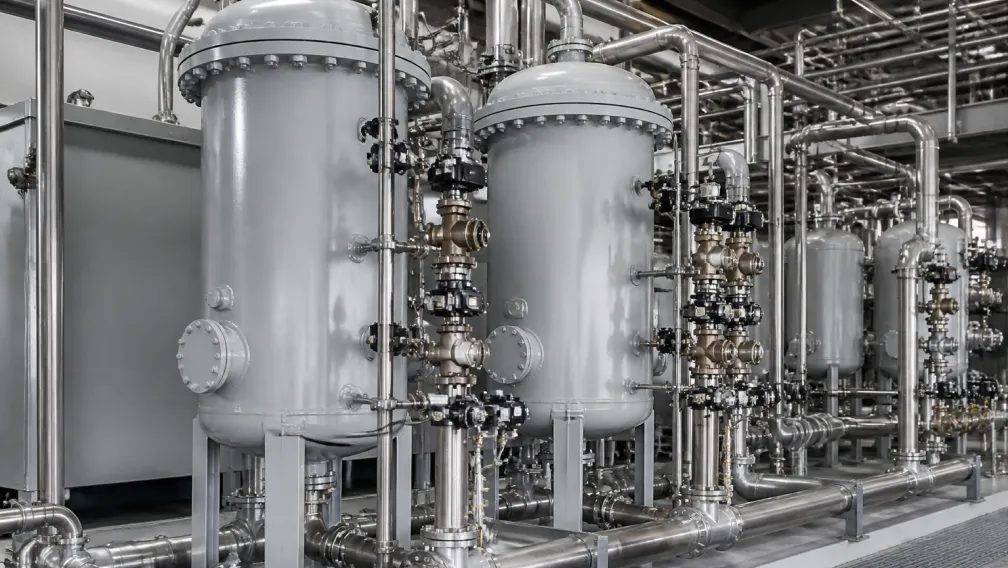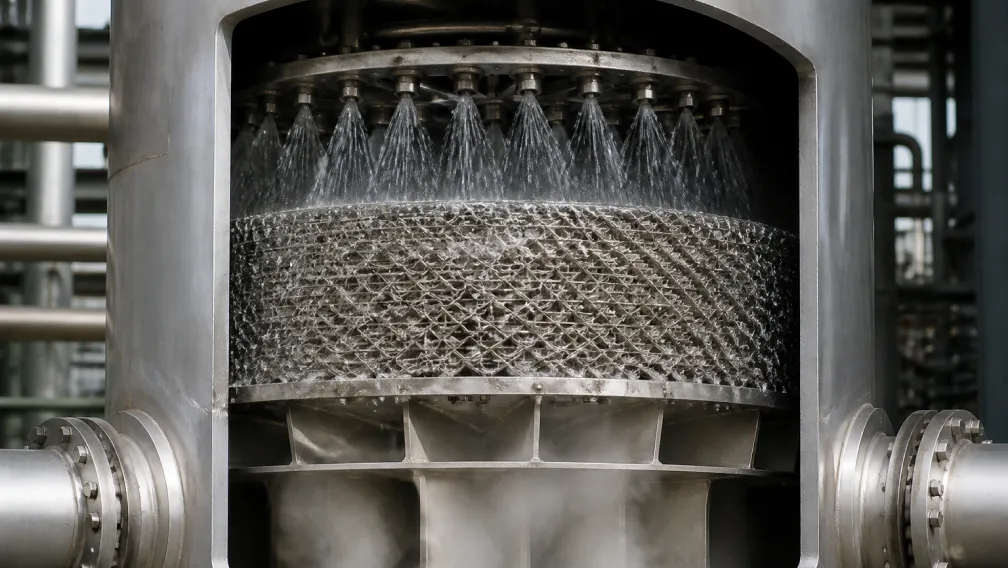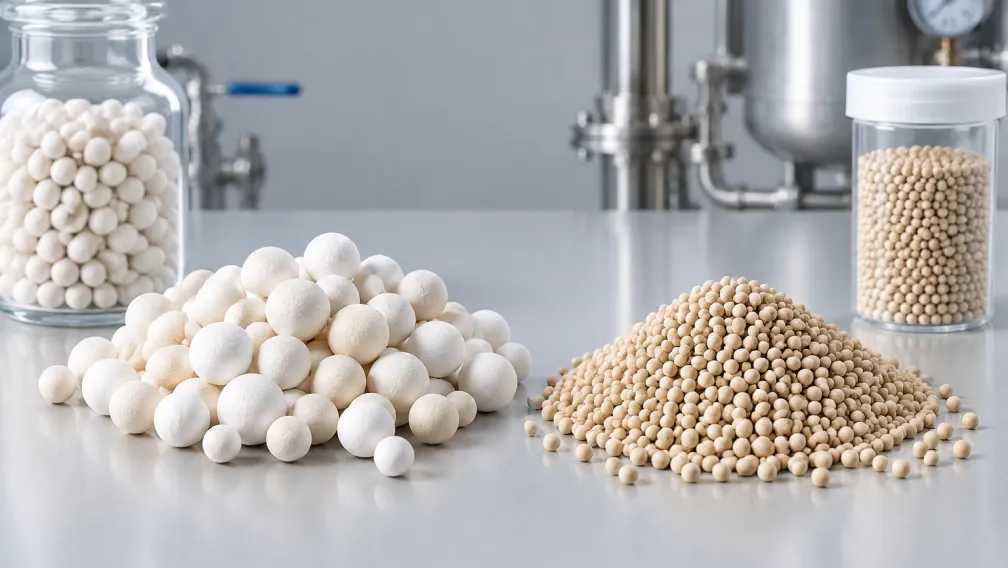

A molecular sieve bed spends half its working life being regenerated, and the quality of that regeneration determines how much water the bed can adsorb in the next cycle. Underheated beds carry residual moisture forward cycle after cycle until breakthrough arrives weeks ahead of schedule. Overheated beds age the zeolite faster than the process requires. This guide covers the regeneration methods used in industrial drying and purification, the temperature profile a thermal swing cycle should follow, grade-specific temperature windows, and the operating practices that decide whether a sieve charge lasts three years or six.
Why Regeneration Quality Sets Working Capacity
Adsorption capacity on a regenerated bed is never the nameplate equilibrium capacity. Even a correctly run thermal cycle leaves a residual water loading of roughly 4 wt% on the zeolite — moisture that the heating step cannot remove economically. The usable working capacity is the difference between that residual loading and the loading at breakthrough. When regeneration falls short, the residual climbs: each incomplete cycle starts the next adsorption step with part of the pore volume already occupied, and capacity erodes progressively rather than all at once.
Field data from drying service shows the consequence clearly. Beds regenerated consistently below about 180 °C lose 30 to 40 percent of working capacity within weeks, and operators compensate by shortening cycle times — which increases the number of regenerations per day and accelerates the decline further. Regeneration temperature, heating time, purge flow, and cooling all have to be correct together; a single weak parameter defeats the other three.
TSA, PSA, and Hybrid Regeneration
Three regeneration mechanisms cover industrial molecular sieve service, and they produce very different working capacities per pass.
| Method | Mechanism | Typical Conditions | Cycle Length | Working Capacity | Typical Service |
|---|---|---|---|---|---|
| TSA (thermal swing) | Heated purge gas desorbs adsorbates | 200–315 °C regeneration temperature | 4–24 h | 10–14 wt% | Natural gas dehydration, air pre-purification, solvent drying |
| PSA (pressure swing) | Depressurization plus product-gas purge | 7–10 bar down to 0.5–1 bar | Seconds to 15 min | 2–4 wt% | Air separation, hydrogen purification, oxygen generation |
| Hybrid TSA + PSA | Moderate heating combined with pressure swing | 120–200 °C plus reduced pressure | Minutes to hours | Between the two | LNG pretreatment, large air separation units |
TSA delivers the deepest regeneration and the highest working capacity per cycle, at the cost of a heat source and long heating-cooling periods. PSA regenerates with no heater and cycles fast, but each pass removes less, so it suits separations where the adsorbate load is small and cycle frequency is acceptable. Hybrid systems appear where the gas volume is large enough that pure TSA energy consumption becomes punitive.
The TSA Temperature Profile, Step by Step
A thermal swing regeneration follows a recognizable temperature course, and the outlet gas temperature tells the operator which phase the bed is in. Taking a 12-hour natural gas dehydration cycle as the reference:
Warm-up. Heated regeneration gas — usually a slipstream of dried gas or nitrogen — enters the bed counter-current to the adsorption flow. Counter-current heating matters: it guarantees that the bottom of the bed, the zone that polishes the product gas to its final dew point, receives the most complete regeneration. The heating ramp should stay near 5 to 10 °C per minute. Faster ramps crack beads through thermal shock, and the resulting dust raises bed pressure drop for the rest of the charge's life.
Desorption plateau. As the bed approaches roughly 120 °C, adsorbed water begins to evaporate in quantity. The temperature rise slows because a large share of the incoming heat is consumed by desorption — around half of the total regeneration energy goes into driving water off the zeolite, with about 30 percent heating the vessel and charge and the remaining 20 percent lost through the structure.
Completion. Once the water front has passed, the outlet temperature climbs again. Regeneration is considered complete when the outlet regeneration gas reaches 180 to 190 °C for standard 4A drying service; heavier co-adsorbed hydrocarbons or CO₂ push the requirement higher. Stopping the heater at a fixed time rather than a verified outlet temperature is the most common cause of incomplete regeneration.
Cooling. The bed is then cooled with dry gas before returning to adsorption. Cooling gas temperature should not fall below about 50 °C at the outlet during the switchover, otherwise moisture in the cooling stream can re-adsorb on the freshly regenerated zeolite. A bed returned to service still warm also shows reduced initial capacity, because adsorption equilibrium favors lower temperatures.
Regeneration Windows by Grade
Different sieve chemistries tolerate different thermal conditions. Exceeding the window ages the binder and crystal structure; staying below it leaves capacity on the table.
- 3A (potassium form): 200–260 °C for ethanol and cracked-gas drying. Lower temperatures suffice because water is the only adsorbate and desorbs cleanly.
- 4A (sodium form): 200–300 °C depending on co-adsorbed species. Natural gas dehydration typically targets a 220–260 °C peak.
- 5A (calcium form): 200–300 °C. Beds that co-adsorb hydrocarbons need the upper end of the range to strip them.
- 13X (sodium X-form): 200–315 °C. Air pre-purification units that load both water and CO₂ regenerate toward the top of this window to clear the more strongly held CO₂.
Failures That Shorten Sieve Life
Liquid water carryover. The single most destructive event for a sieve bed. Liquid water contacting hot zeolite during regeneration causes hydrothermal attack on the crystal and binder; beads lose crush strength, powder, and plug the bed with fines. Upstream separation must be treated as part of the regeneration system, since carryover usually arrives during upset conditions.
Chronic underheating. Running 20 to 30 °C below the required outlet temperature to save fuel costs more than it saves: capacity decays within weeks, cycle times shrink, and total regenerations — each with its own thermal stress — multiply.
Insufficient purge flow. Heat alone does not regenerate a bed. The purge stream carries desorbed water out of the vessel; starved purge flow leaves a wet heel at the far end of the bed that no amount of extra heating time fully removes.
Rapid thermal cycling. Aggressive heat-up and cool-down ramps generate thermal shock fractures. The dust produced migrates to support screens and raises pressure drop long before the zeolite itself loses activity.
Regeneration gas selection. The purge stream must be dry enough to accept desorbed water without re-wetting the bed. Closed systems use heated nitrogen circulated through a cooler and separator; natural gas units typically divert a slipstream of dried product gas, condense the recovered water, and return the gas to the inlet. Whatever the source, monitoring the dew point of the regeneration outlet gas is the most direct verification that a cycle has actually completed — the outlet dew point falls sharply once the water front has cleared the bed.
Reducing Regeneration Energy
Because desorption heat dominates the energy balance, the practical savings come from three directions. Internal vessel insulation attacks the structural heat loss directly and can recover around a fifth of total regeneration energy. Waste heat recovery between the hot regeneration outlet and the cold inlet stream preheats the purge gas and cuts heater duty substantially on continuous units. And cycle timing matched to measured breakthrough — rather than a conservative fixed clock — avoids regenerating beds that still hold usable capacity. Grade selection also belongs in this discussion: a sieve grade matched to the actual adsorbates regenerates at the lowest temperature the duty allows, and our comparison of activated alumina and molecular sieve covers the energy trade-off where an alumina guard layer can absorb the bulk water load upstream of the sieve.
End-of-Life Diagnostics
Three trends together mark a sieve charge approaching replacement. Regeneration temperature has been raised 20 to 30 °C above the commissioning value to hold the dew point specification. Adsorption cycle times have shortened to keep breakthrough in spec. Bed pressure drop is climbing as attrition dust accumulates. Any one of these alone can have other causes; all three together mean the zeolite's capacity is spent, and planning replacement beats waiting for a breakthrough event.
Specify the Right Sieve for the Cycle
Regeneration performance starts with the adsorbent specification: bead size for the bed's pressure drop budget, crush strength for the thermal cycle count, and the grade matched to the adsorbates. Send your regeneration temperature, cycle time, purge gas, and outlet dew point target through our contact page for a grade and sizing review, or see the selection framework on our desiccant selection page.
-

Rongjian
Process Media Manufacturer Since 2010
Rongjian produces tower packing, molecular sieves, ceramic grinding media and other process media from our Pingxiang production base. We supply to industrial projects in over 100 countries.